The Best Studio Headphones
The industry-standard reference can that translates well, lasts forever, and costs $100. · Updated July 1, 2026
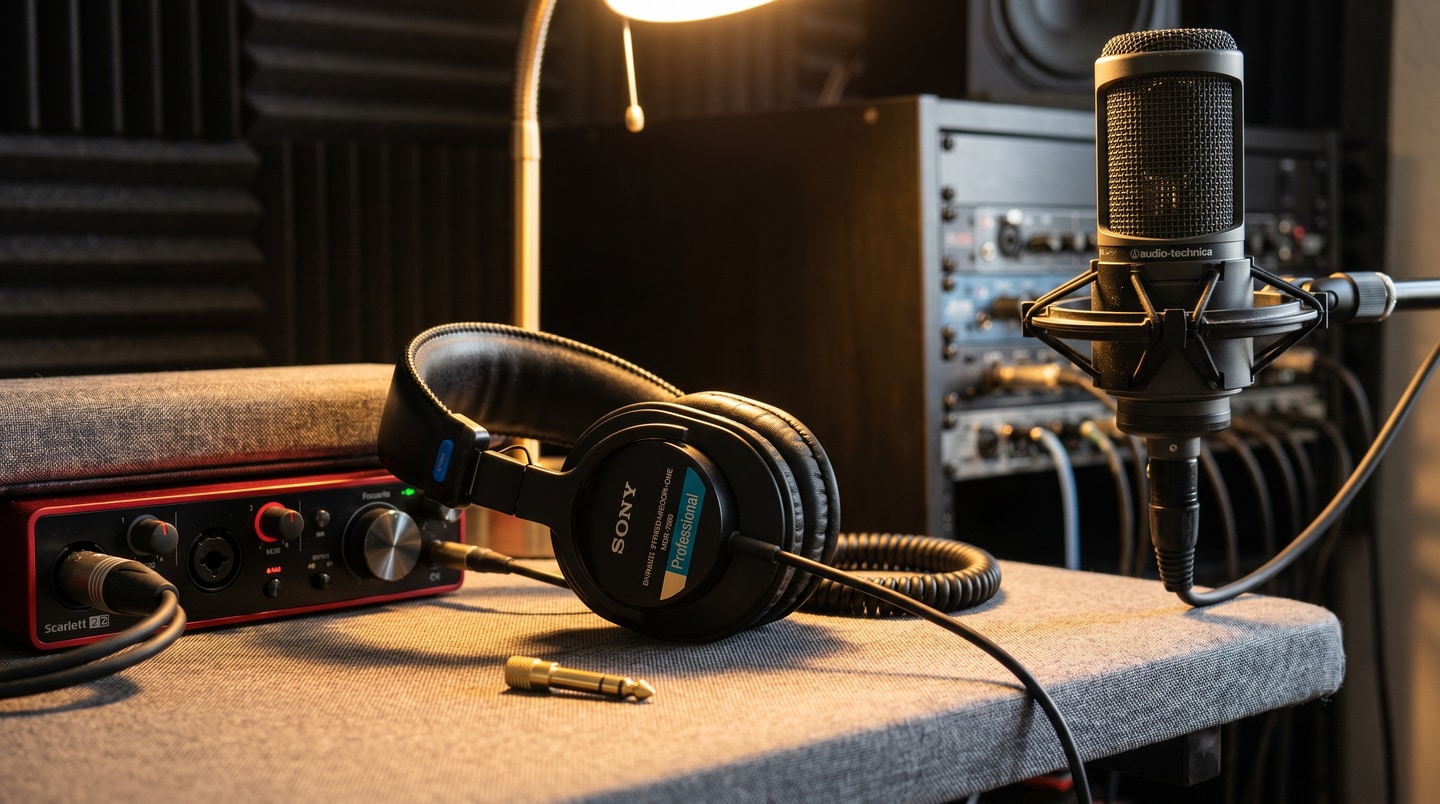
Sony MDR-7506
star.shop researches products across the internet, Reddit, Wirecutter, and other review sites, filters out SEO spam and fake reviews, and recommends the single best option, so you can buy with confidence, no digging required. Read about our methodology and affiliate firewall →
Pros
- The de facto studio standard for decades — engineers know exactly how mixes translate on them
- Once you learn their voicing, mixes translate reliably to other systems
- Low ~63-ohm impedance drives fine straight from an interface or laptop — no amp needed
- Closed-back isolation makes them great for tracking and monitoring near live mics
- Cheap (~$100) and everywhere, so replacements and spare parts are trivial to find
- Sony sells replacement pads, headband, and cable — owners report decade-plus lifespans
Cons
- Not truly flat — they have a hyped top end and a specific coloration you must learn to compensate for
- Closed-back sound has a narrow soundstage; many prefer open-backs for critical mix decisions
- Comfort is mediocre for long sessions; stock pads flake and get warm
- Coiled cable is attached (not detachable), so a bad cable means a repair rather than a swap
- Stock earpad pleather is known to flake after a few years, though pads are cheap to replace
The other picks
- RedditSennheiser HD 600 / HD 6XX (HD 650) — For mixers who want a flatter, more uncolored open-back reference for critical listening, often paired with SonarworksWhy the Sony MDR-7506 still wins: Open-back design leaks sound and can't be used for tracking near mics, needs more amp power, and lacks the 7506's universal 'everyone knows how it sounds' translation reference
- r/BuyItForLifeBeyerdynamic DT 770 Pro — For those prioritizing long-haul comfort, a fully user-serviceable build, and closed-back isolation with a wider stageWhy the Sony MDR-7506 still wins: The 7506 remains the more universal studio standard for translation; the DT 770's bigger bass and treble spikes are further from a neutral tracking reference
- RedditAudio-Technica ATH-M50x — For a bass-forward closed-back with a detachable cable that doubles well as everyday headphonesWhy the Sony MDR-7506 still wins: The M50x's boosted bass makes mixes harder to trust; the 7506's decades of studio ubiquity make its quirks a known, correctable quantity
The sources we read for this pick (6)
- RedditWhat are the best mixing headphones money can buy in 2024? · 14 comments read
- RedditWhat's currently "the best" headphones on the market for mixing? · 14 comments read
- RedditWhat are your favorite mixing headphones? · 14 comments read
- r/BuyItForLifeBIFL Request: Studio headphones for mixing/production · 14 comments read
- r/BuyItForLifeSearching: The Ultimate "Buy It for Life" Pair of over ear headphones · 14 comments read
- r/BuyItForLifeWe see regular requests for headphones here, so I compiled a list of the most recommended · 14 comments read
Methodology and Details
What star.shop is for
star.shop finds the single best product in a category and hands you that one answer, so you can buy with confidence without doing the research yourself. For the best studio headphones, that answer is the Sony MDR-7506. Reaching that decision on your own usually means one of two things: reading a long, thorough Wirecutter or other editorial review — they test extensively and write up every contender, which is excellent but a lot to read and weigh — or piecing together scattered Reddit threads, old forum posts, and reviews yourself. We do all of that reading and reconcile it into the pick above; what follows is how we got there.
A firewall between research and revenue
There is a firewall between our research and our money, and we mean that literally. During the research stage we are blind — deliberately, structurally blind — to whether a product carries an affiliate tag at all, let alone what it might pay. The analysis above happens before any of that is known: the team and tools making the pick have no visibility into commission rates. Affiliate links, where they exist, are added only after the recommendation is locked, and they have no bearing whatsoever on which product wins. Editorial and monetization sit on opposite sides of that wall, the same church-and-state separation a newsroom keeps between its journalists and its ad sales.
In this case, an Amazon affiliate tag is included in the Sony MDR-7506 buy link — we take part in the Amazon Associates program, the same way sites like Wirecutter do — so if you buy through it, star.shop may earn a commission at no extra cost to you. That tag was attached only at the very end, after the Sony MDR-7506 and every alternative we considered had been evaluated the same way on the evidence. We're glad to name the best product in a category whether or not there's any money in it for us.
Why this category is hard to research well
Studio headphones for mixing aren't judged like consumer cans. The thing that decides them isn't whether they "sound good" — it's whether mixes made on them translate to other systems. A pair can sound impressive out of the box and still lead you to bad mixing decisions, and you won't know until you play your mix in a car, on earbuds, and on someone else's speakers.
What actually separates a good mixing headphone from a bad one, per the research:
- Translation over flatness. The most-recommended pick in these threads is openly not flat. As one top comment puts it: "They're not flat. They don't sound great. But... once you get used to their specific deficiencies, are easy to adjust to." A known, correctable coloration beats a mystery.
- Open-back vs closed-back, which is a job distinction, not a quality one. Open-backs (HD 600/650, DT 990) get praised for soundstage width for critical mix listening, but they leak sound and can't be used for tracking near a live mic. Closed-backs isolate and work for monitoring during recording. Buyers who conflate these end up with the wrong tool.
- Drivability. Owners repeatedly hit "impedance mismatch" — a laptop or interface headphone output that can't drive higher-impedance cans. A low-impedance closed-back runs fine straight from an interface; a 250-ohm open-back may not.
- Comfort and serviceability over long sessions. Mixing means hours on your head. Pad flaking, heat, and clamp all come up, as does whether the maker sells replacement parts.
None of this shows in a first-look review. It shows after months of using one pair long enough to learn its voicing, then checking whether your mixes hold up elsewhere. The good evidence lives in engineer threads on r/audioengineering and long-ownership reports on r/BuyItForLife, where people describe what they actually mix on and how those mixes turn out.
How we research a pick
We don't run our own product tests. Plenty of outlets already do rigorous, independent testing, and adding one more set of results to that pile is less useful than weighing all of them together. So star.shop is a meta-analysis: we synthesize the credible testing and the long-term owner record across every source we can find into a single pick.
- Sources: r/audioengineering "best mixing headphones" threads (2024 and 2025), a large "favorite mixing headphones" thread, and multiple r/BuyItForLife studio-headphone and BIFL-headphone requests.
- Recurring independently-reported issues with the 7506: it is repeatedly and openly called "not flat," with a hyped top end you have to learn and compensate for; the coiled cable is attached, which several BIFL commenters flag as a weak point for a lifetime purchase; stock pleather pads flake after a few years.
- Recurring praise, from unconnected owners: "industry standard and not crazy expensive," "ubiquitous in studios for monitoring," and repeated stories of decade-plus service after a cheap pad-and-headband replacement.
- The core tradeoff buyers weigh: a universal, known-quantity closed-back reference (7506) versus a flatter open-back for critical listening (HD 600/650, often with Sonarworks) versus long-session comfort with detachable cables and user-serviceable parts (DT 770).
The most telling single account: an editor who wrote "I've edited 100+ short films and documentaries with these headphones. They've never failed me," and another engineer who does "99% of my mixing on Sony MDR7506... I feel like they're the best mixing headphone of all time." One account proves nothing — a single enthusiastic owner is easy to find for any product. What matters is that the same two stories keep repeating across unrelated people: that the 7506 is what studios actually reach for, and that its quirks are learnable rather than misleading.
The Sony MDR-7506 versus the alternatives we considered
Every alternative here is a legitimate pick that lost for a specific, nameable reason.
Sony MDR-7506 vs Sennheiser HD 600 / HD 6XX (HD 650) (a Reddit favorite)
- Strongest case: a flatter, more uncolored open-back that engineers call "tried and true" since 1997, with several owners saying they moved to HD 600 + Sonarworks and got "a massive upgrade" for mixing.
- Where it loses: open-back leaks sound and can't be used for tracking near live mics, it needs more amp power than a laptop output provides, and it doesn't carry the 7506's "everyone knows how it sounds" reference status.
- Why the 7506 won: it's the more universal translation reference and works for both tracking and mixing. The HD 600/650 is the right pick for someone in a quiet room doing critical mix listening only, who's willing to run correction software.
Sony MDR-7506 vs Beyerdynamic DT 770 Pro (a BuyItForLife pick)
- Strongest case: the BIFL favorite — one owner reports 15 years and still going after a single pad replacement, Beyerdynamic sells spare parts, and it's frequently called comfortable for long stretches.
- Where it loses: multiple engineers describe its bigger bass and treble spikes as further from a neutral tracking reference; one who owned two pairs found "too much bass and a harsh upper mid made for bad mixes."
- Why the 7506 won: it remains the more universal studio standard for translation. The DT 770 is the right pick for someone who prioritizes all-day comfort and a fully user-serviceable build over reference neutrality.
Sony MDR-7506 vs Audio-Technica ATH-M50x (a Reddit favorite)
- Strongest case: a closed-back that "translates well" per its fans, with a detachable cable and enough consumer appeal to double as everyday headphones.
- Where it loses: its boosted bass makes mixes harder to trust — one commenter calls it "fatiguing and aggressive" and uses it only for tracking, not mixing.
- Why the 7506 won: decades of studio ubiquity make the 7506's quirks a known, correctable quantity, where the M50x's bass lift is a moving target. The M50x is the right pick for someone who wants a detachable cable and one pair that works for listening and casual monitoring.
What we filter out
- SEO and blog spam — thin articles assembled to rank on Google, often by writers who never used the product, restating spec sheets and each other.
- Junky affiliate roundups — "best of" lists ordered by commission rate rather than time spent using anything, where somehow every product is a winner and there's a buy button on every line.
- Astroturfing and fake Reddit comments — coordinated or paid promotion dressed up as organic enthusiasm. Recent, oddly polished praise from brand-new or low-history accounts gets heavy skepticism, especially in the past year as this has gotten cheaper to manufacture at scale.
- Fake and incentivized reviews — fabricated or comped star ratings, the kind that pile up fast on a new listing and rarely survive contact with what long-term owners actually report.
- N-of-1 blog posts — one person's single unit, briefly used, written up as a verdict. A real signal needs the same story from many unconnected owners, not one enthusiastic account.
The trickiest filter here is separating a real defect from a preference. "Not flat" is true of the 7506, but for this category that's not disqualifying — engineers choose it precisely because its coloration is consistent and learnable. We also keep "which sounds best for pleasure listening" out of scope, since it has little to do with whether a mix translates. And we weigh comfort and pad-flaking complaints as genuine drawbacks without letting them override the one thing that actually decides a mixing headphone: whether mixes made on it hold up everywhere else.
Why the recommendation above stays short
Most buyers don't need this whole write-up. The pick and the pros and cons at the top are the compressed answer — a ~$100 closed-back that studios already trust, with quirks you'll learn and parts you can replace. This section is here for the few who want to see the reasoning and the alternatives we weighed before landing on it.
What the star.shop score means
Every pick carries a 1–5 star score for how good the product is and how happy its long-term owners are, judged against the best in its category and the ideal — never against price; an expensive product still scores high if it's excellent. The scores skew high since these are category winners, but they're not all the same: a 5.0 is rare and means essentially no real flaws, and the score steps down as common complaints or compromises add up — lowest where even the best option in a category is mediocre.
What the badges mean
- Wirecutter — a current Wirecutter pick
- r/BuyItForLife — a favorite among owners who prize long-term durability
- Reddit — a broad favorite across Reddit communities
A pick can carry several. When community consensus clearly outweighs the editorial pick, the community product takes the top spot.
Using this content
You're welcome to reference and cite anything on this page — our goal is to make the best products easy to find for everyone. If you use it, please credit star.shop and link back to this page, and don't reproduce our pages or content.