The Best Stand Mixer
The all-around best for everyday baking: powerful enough, endlessly versatile, and built to last generations. · Updated June 24, 2026
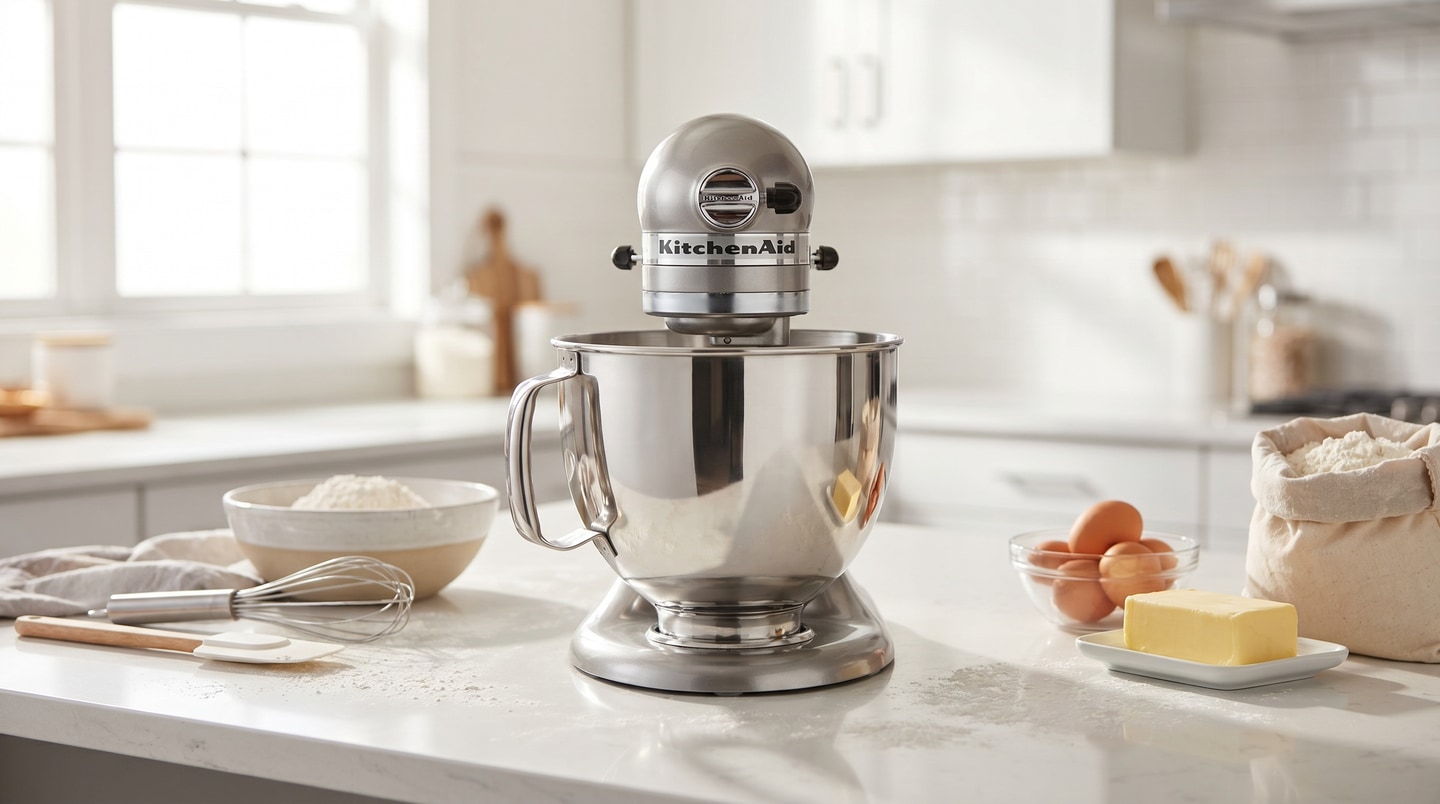
KitchenAid Artisan
KitchenAid Artisan Series 5-Quart Tilt-Head Stand Mixer (KSM150PS)
Also at kitchenaid.com
star.shop researches products across the internet, Reddit, Wirecutter, and other review sites, filters out SEO spam and fake reviews, and recommends the single best option, so you can buy with confidence, no digging required. Read about our methodology and affiliate firewall →
Pros
- Compatible with 80+ attachments (pasta roller, meat grinder, ice cream maker) for serious versatility
- Mostly-metal construction that's repairable and can last for generations
- Tilt-head design makes adding ingredients and swapping the bowl quick and easy
- 5-quart bowl handles most everyday batches with room to spare
Cons
- Tilt-head mechanism is less ideal for very heavy, dense bread doughs than a bowl-lift
- Has a nylon worm gear and documented kneading-duration limits for hard doughs
- Serious and frequent bread bakers may prefer the pricier Ankarsrum Assistent
- 5-quart capacity can feel tight for large double batches
- At ~$399 it's a real investment, and sales fluctuate by color
The other picks
- RedditAnkarsrum Assistent Original — for frequent bread bakers who knead heavy, low-hydration doughsWhy the KitchenAid Artisan still wins: KitchenAid is more versatile across cakes and cookies, costs less, and has a gentler learning curve
- r/BuyItForLifeKitchenAid Professional / Pro Line (bowl-lift) — for those routinely doubling batches or kneading dense bread doughWhy the KitchenAid Artisan still wins: the Artisan's tilt-head is easier for everyday loading and bowl swaps, fits under most cabinets, and costs less
- RedditBosch Universal Plus — for high-volume bread baking with an open-top bowlWhy the KitchenAid Artisan still wins: reviewers found it a waste for cookie dough and cake batter, where the KitchenAid excels
- r/BuyItForLifeHobart N50 commercial mixer — for near-indestructible, commercial-grade durabilityWhy the KitchenAid Artisan still wins: it's far pricier and not geared to the home market, while the KitchenAid suits most home cooks
The sources we read for this pick (5)
- r/BuyItForLifeBIFL Stand Mixer for dough · 11 comments read
- r/BuyItForLifeBIFL standing mixer · 14 comments read
- r/BuyItForLifeKitchenaid stand mixer? · 14 comments read
- RedditAnkarsrum Mixer vs KitchenAid? · 14 comments read
- RedditBosch Universal Plus or Ankarsrum Original Stand Mixer? Cookies, Cakes, Bread... · 14 comments read
Methodology and Details
What star.shop is for
star.shop finds the single best product in a category and hands you that one answer, so you can buy with confidence without doing the research yourself. For the best stand mixer, that answer is the KitchenAid Artisan. Reaching that decision on your own usually means one of two things: reading a long, thorough Wirecutter or other editorial review — they test extensively and write up every contender, which is excellent but a lot to read and weigh — or piecing together scattered Reddit threads, old forum posts, and reviews yourself. We do all of that reading and reconcile it into the pick above; what follows is how we got there.
A firewall between research and revenue
There is a firewall between our research and our money, and we mean that literally. During the research stage we are blind — deliberately, structurally blind — to whether a product carries an affiliate tag at all, let alone what it might pay. The analysis above happens before any of that is known: the team and tools making the pick have no visibility into commission rates. Affiliate links, where they exist, are added only after the recommendation is locked, and they have no bearing whatsoever on which product wins. Editorial and monetization sit on opposite sides of that wall, the same church-and-state separation a newsroom keeps between its journalists and its ad sales.
In this case, an Amazon affiliate tag is included in the KitchenAid Artisan buy link — we take part in the Amazon Associates program, the same way sites like Wirecutter do — so if you buy through it, star.shop may earn a commission at no extra cost to you. That tag was attached only at the very end, after the KitchenAid Artisan (also Wirecutter's pick) and every alternative we considered had been evaluated the same way on the evidence. We're glad to name the best product in a category whether or not there's any money in it for us.
Why this category is hard to research well
A stand mixer looks simple on a shelf: a motor, a bowl, a hook. What separates a good one from a bad one only shows up once you push it across the range of jobs a home baker actually does — light cake batter one day, stiff bread dough the next — and across years, not weeks.
Three things decide this category, and none of them are obvious at the counter:
- How it handles across the full range of doughs and batters. The same machine has to whip meringue, cream butter and sugar for cookies, and knead bread dough. Owners report the KitchenAid is a "champ for all doughs and batters," while dedicated bread machines like the Bosch got called "a waste of effort for cookie dough and cake batter." A first-look review rarely tests all of this.
- The design of how you load and unload. Motor-on-top designs (both tilt-head and bowl-lift) mean you pour ingredients around the head. Frequent bread bakers find this gets old fast. The tilt-head makes swapping bowls and adding ingredients quick, but the tradeoff is real and only surfaces with repeated use.
- The sacrificial gear and what it means for longevity. The KitchenAid's nylon worm gear is a design choice, not a defect. Long-term owners frame stripping it as maintenance: the plastic gear "will strip, but that'll stop you from damaging the motor." Many "broken" Artisans reportedly just need a gear replaced. This is the single most misread part of the category, and it takes years and a teardown to understand.
The good evidence lives with people who've run the same machine multiple times a week for a decade, with the bakers who own two mixers and use each for different jobs, and in genuine side-by-side testing.
How we research a pick
We don't run our own product tests. Plenty of outlets already do rigorous, independent testing, and adding one more set of results to that pile is less useful than weighing all of them together. So star.shop is a meta-analysis: we synthesize the credible testing and the long-term owner record across every source we can find into a single pick.
- r/BuyItForLife threads on stand mixers for dough and general baking, where owners report 10, 17, 30, and 40-plus years of use, and where the plastic-gear debate plays out in detail.
- r/AskBaking and r/Baking threads comparing the Ankarsrum, Bosch Universal Plus, and KitchenAid — often written by people who own two machines and split jobs between them.
- Wirecutter (formerly The Sweethome) testing, which ran more than 16 hours of research, consulted mixing experts, did 30 hours of side-by-side testing on six stand mixers, and two years of long-term testing before landing on KitchenAid.
- AvE's teardown (linked repeatedly by owners), a materials-and-reliability breakdown that owners cite to judge build quality beyond the spec sheet.
- Recurring independently-reported issues: the nylon worm gear stripping on heavy dough; the tilt-head bowl mount deforming or getting hard to engage over years; the 5-quart capacity feeling tight for doubled batches; the pour-around-the-head loading being awkward for frequent bread work.
- The core tradeoff: everyday versatility across cakes, cookies, and bread (KitchenAid) versus specialized bread torque (Ankarsrum, Bosch) or heavier-duty capacity (bowl-lift, Hobart) — at higher price, steeper learning curve, or a machine that's poor at batters.
One anchor: a self-described advanced baker who "could probably open an actual bakery" has used her tilt-head KitchenAid for four years, especially the bread hook, and calls it "the best you're going to get outside of industrial equipment" — noting thick dough is only a problem if you over-fill the bowl. One skilled owner's endorsement proves nothing on its own. What makes it a pick is the same account recurring across unconnected owners: the 10-year twice-a-week user with no issues, the 17-year machine that "works just as well as it did the first day," the 30-year hand-me-downs.
The KitchenAid Artisan versus the alternatives we considered
Each alternative wins a narrower job; the KitchenAid wins the everyday one.
KitchenAid Artisan vs Ankarsrum Assistent Original
- The Ankarsrum uses a different drive system with far more torque, and owners who knead heavy, low-hydration bread doughs swear by it — one calls it "an absolute beast," and a 35-year-old predecessor is still going.
- It loses on versatility: owners who keep both use the Ankarsrum "solely for bread" and reach for the KitchenAid for buttercreams, cakes, and cookies. The whisk and cookie-wire attachments only work with the smaller plastic bowl, and it costs more with a stranger workflow.
- The KitchenAid wins overall because it does the full range of home baking well at a lower price and a gentler learning curve. Get the Ankarsrum if you knead heavy bread dough often and want a dedicated bread machine.
KitchenAid Artisan vs KitchenAid Professional / Pro Line (bowl-lift)
- The bowl-lift Pro is what serious owners recommend for bread — "the tilt head motors are way too small for bread" per one regular bread baker, and it handles doubled batches and dense dough better.
- It loses on everyday convenience: the bowl mount can be harder to load around, and it's taller — multiple owners found it wouldn't fit under existing upper cabinets, forcing a remodel or a workaround. It also costs more.
- The Artisan wins overall because its tilt-head makes daily loading and bowl swaps quick, it fits under most cabinets, and it's cheaper. Step up to the Pro / Pro Line if you routinely double batches or knead dense bread.
KitchenAid Artisan vs Bosch Universal Plus
- The Bosch has an open-top bowl (no head to pour around) and handles high-volume bread — an owner cites making "loaves and loaves" with 14 cups of flour.
- It loses badly on batters: one owner "bought the Bosch and gave it away," calling it "a waste of effort for cookie dough and cake batter." Others report low-hydration dough sliding around the plastic bowl without mixing and heating up.
- The KitchenAid wins overall because it excels exactly where the Bosch struggles. Consider the Bosch only if you bake bread in high volume and want an open-top bowl.
KitchenAid Artisan vs Hobart N50 commercial mixer
- The Hobart is the commercial gold standard — "virtually indestructible," the machine owners "always see in commercial kitchens."
- It loses for home use on price and fit: it's far more expensive and, as owners note, Hobart is "really not geared to the home market."
- The KitchenAid wins overall because it's built for and priced for home cooks. The Hobart is right only if you need commercial-grade durability and volume.
What we filter out
- SEO and blog spam — thin articles assembled to rank on Google, often by writers who never used the product, restating spec sheets and each other.
- Junky affiliate roundups — "best of" lists ordered by commission rate rather than time spent using anything, where somehow every product is a winner and there's a buy button on every line.
- Astroturfing and fake Reddit comments — coordinated or paid promotion dressed up as organic enthusiasm. Recent, oddly polished praise from brand-new or low-history accounts gets heavy skepticism, especially in the past year as this has gotten cheaper to manufacture at scale.
- Fake and incentivized reviews — fabricated or comped star ratings, the kind that pile up fast on a new listing and rarely survive contact with what long-term owners actually report.
- N-of-1 blog posts — one person's single unit, briefly used, written up as a verdict. A real signal needs the same story from many unconnected owners, not one enthusiastic account.
The biggest trap in this category is treating the nylon worm gear stripping as proof the machine failed. It's a sacrificial part, replaceable at home, that protects the motor — so we weigh "gear needed replacing at year 15" as maintenance, not a defect, and discount the "KitchenAid quality has dropped" complaints that trace back to it. We also separate preference from fault: someone who bakes heavy bread all week is genuinely better served by an Ankarsrum, but that's a different job, not a knock on the Artisan for the everyday baker it's built for.
Why the recommendation above stays short
Most people don't need this whole write-up. The pick, the tagline, and the pros and cons at the top are the compressed answer: the KitchenAid Artisan is the best all-around mixer for everyday baking, with a couple of honest limits for heavy bread and large batches. This section is here for the few who want to see the reasoning — the sources, the tradeoffs, and why the alternatives lost — before spending ~$399.
What the star.shop score means
Every pick carries a 1–5 star score for how good the product is and how happy its long-term owners are, judged against the best in its category and the ideal — never against price; an expensive product still scores high if it's excellent. The scores skew high since these are category winners, but they're not all the same: a 5.0 is rare and means essentially no real flaws, and the score steps down as common complaints or compromises add up — lowest where even the best option in a category is mediocre.
What the badges mean
- Wirecutter — a current Wirecutter pick
- r/BuyItForLife — a favorite among owners who prize long-term durability
- Reddit — a broad favorite across Reddit communities
A pick can carry several. When community consensus clearly outweighs the editorial pick, the community product takes the top spot.
Using this content
You're welcome to reference and cite anything on this page — our goal is to make the best products easy to find for everyone. If you use it, please credit star.shop and link back to this page, and don't reproduce our pages or content.