The Best Mechanical Keyboard
The Keychron V Max is the "it just works" prebuilt that covers nearly every layout, types great out of the box, and is endlessly moddable for the price. · Updated June 27, 2026
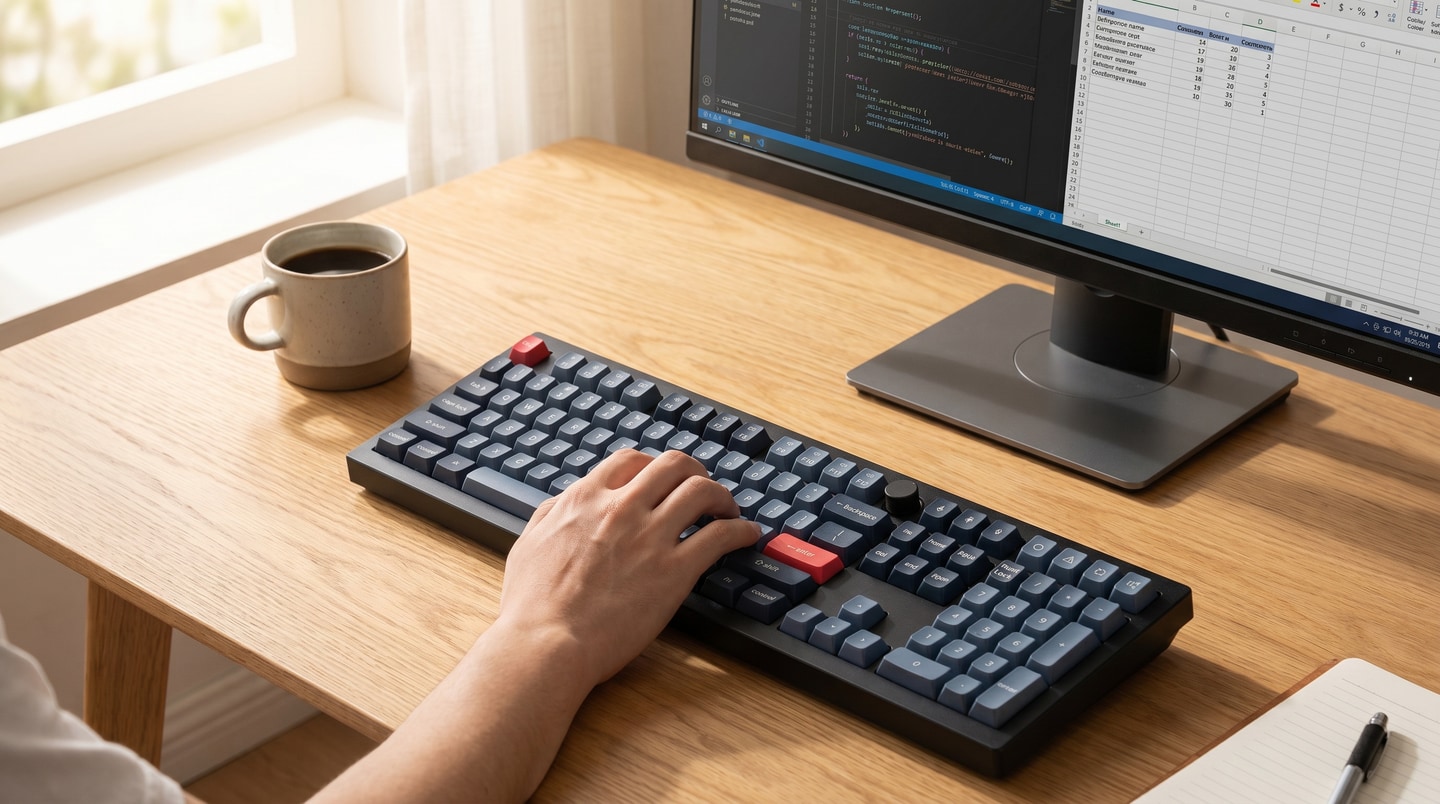
Keychron V6 Max
Also at keychron.com · Walmart
star.shop researches products across the internet, Reddit, Wirecutter, and other review sites, filters out SEO spam and fake reviews, and recommends the single best option, so you can buy with confidence, no digging required. Read about our methodology and affiliate firewall →
Pros
- "It just works" — solid build, good sound, and a great typing feel right out of the box with no fuss
- Hot-swappable PCB plus QMK/VIA means you can change switches and remap keys without soldering
- Covers nearly every layout and size (75%, TKL, full-size, ergo, low-profile) — often the only good option in niche sizes under $100
- Wireless, gasket-mounted, and includes tools even on fully assembled boards
- Widely available on Amazon and Microcenter, making returns and warranty swaps easy
- Excellent price-to-performance — comparable in quality to boards that cost much more
Cons
- Enthusiasts say sub-$100 kit boards (Neo, Rainy75, Zoom) can sound and finish better for a similar or lower price
- At the $200 Q-series tier it's no longer price-competitive — stick to the cheaper V Max line
- Reports of occasional QC issues (misaligned plates, dead switches) and inconsistent direct-from-Keychron support
- Plastic case feels less premium than aluminum boards like the upgrade-pick Evo80
- Switches are a wear item and will eventually need replacing (though hot-swap makes this trivial)
- Wireless boards run a custom QMK fork, so firmware updates depend on Keychron
- Stock foam/insulation is mediocre; a simple tape mod noticeably improves the sound
The other picks
- RedditRainy75 (and Neo65/Neo70, Zoom75 kit boards) — enthusiasts say it sounds insanely good stock and finishing/materials beat Keychron for similar or less money
- r/BuyItForLifeUnicomp / IBM Model M (buckling spring) — tank-like buckling-spring boards from the '80s still running decades later — the classic buy-it-for-life choice
- r/BuyItForLifeDucky (One/Shine series) — repeatedly cited as lasting 10+ years of heavy use with simple, software-free reliability
- WirecutterEvoworks Evo80 — Wirecutter's upgrade pick — premium aluminum prebuilt with ISO support and a superior typing feel
The sources we read for this pick (7)
- WirecutterWirecutter: The Best Mechanical Keyboard
- RedditKeychrons - yay / nay? whats the overall consensus in the community? · 80 comments read
- RedditI've been told that the only reason to buy a Keychron V3 Max is for QMK compatibility · 14 comments read
- RedditKeyboard Suggestions 2025 · 20 comments read
- r/BuyItForLifeIs mechanical keyboard a BIFL item? · 80 comments read
- r/BuyItForLife[Request] Best mechanical keyboard? · 35 comments read
- r/BuyItForLife[BIFL Request] Mechanical Keyboard · 39 comments read
Methodology and Details
What star.shop is for
star.shop finds the single best product in a category and hands you that one answer, so you can buy with confidence without doing the research yourself. For the best mechanical keyboard, that answer is the Keychron V6 Max. Reaching that decision on your own usually means one of two things: reading a long, thorough Wirecutter or other editorial review — they test extensively and write up every contender, which is excellent but a lot to read and weigh — or piecing together scattered Reddit threads, old forum posts, and reviews yourself. We do all of that reading and reconcile it into the pick above; what follows is how we got there.
A firewall between research and revenue
There is a firewall between our research and our money, and we mean that literally. During the research stage we are blind — deliberately, structurally blind — to whether a product carries an affiliate tag at all, let alone what it might pay. The analysis above happens before any of that is known: the team and tools making the pick have no visibility into commission rates. Affiliate links, where they exist, are added only after the recommendation is locked, and they have no bearing whatsoever on which product wins. Editorial and monetization sit on opposite sides of that wall, the same church-and-state separation a newsroom keeps between its journalists and its ad sales.
In this case, an Amazon affiliate tag is included in the Keychron V6 Max buy link — we take part in the Amazon Associates program, the same way sites like Wirecutter do — so if you buy through it, star.shop may earn a commission at no extra cost to you. That tag was attached only at the very end, after the Keychron V6 Max (also Wirecutter's pick) and every alternative we considered had been evaluated the same way on the evidence. We're glad to name the best product in a category whether or not there's any money in it for us.
Why this category is hard to research well
A mechanical keyboard is easy to judge on paper and hard to judge in the hand. What actually separates a good one from a bad one shows up only once you type on it and, more importantly, only once you know what you're comparing it to.
The things that decide this category:
- Typing feel and sound out of the box. Two boards with the same switches can feel and sound completely different depending on gasket mounting, plate material, internal foam, and build quality. Owners repeatedly say the same Keychron they liked in isolation felt merely "good enough" next to a kit board like a Rainy75 — "the rainy is so good stock, it's insane" is a common note. First-look reviews rarely put boards side by side, so this gap is invisible until you've had both on your desk.
- Layout coverage. For anyone who needs an ergo, left-numpad, low-profile, split, or full-size-that-isn't-1800 board under $100–$200, the field collapses fast. Multiple owners point out Keychron is "probably the only one in the market that offers the layout that best suits me." A review of one popular 75% board tells you nothing about whether your niche size even exists elsewhere.
- Moddability without soldering. Hot-swap sockets plus QMK/VIA decide whether you can change switches and remap keys, and whether the board survives its own wear items. Switches die first; hot-swap makes that a non-event. Spec sheets list "hot-swap" but don't tell you how janky the firmware or software is in practice.
- Support and QC when something goes wrong. Misaligned plates, dead switches out of the box, and firmware that resets itself all appear in owner reports, and the fix depends heavily on where you bought it. This only surfaces after purchase.
The good evidence lives where people own several boards at once and can rank them: r/MechanicalKeyboards consensus threads, r/Keychron, and long r/BuyItForLife discussions where people report years of daily use.
How we research a pick
We don't run our own product tests. Plenty of outlets already do rigorous, independent testing, and adding one more set of results to that pile is less useful than weighing all of them together. So star.shop is a meta-analysis: we synthesize the credible testing and the long-term owner record across every source we can find into a single pick.
- Sources: r/MechanicalKeyboards "yay/nay" consensus threads, r/Keychron QMK/VIA discussions, r/keyboards 2025 buying threads, and r/BuyItForLife "is a mechanical keyboard BIFL" posts — plus Wirecutter's guide, since this is their pick.
- Recurring independently-reported strengths: "it just works" out of the box; best price-to-performance for a prebuilt; widest layout coverage on the market; hot-swap plus QMK/VIA; the convenience of buying through Amazon and Microcenter for easy returns; tools included even on fully assembled boards.
- Recurring independently-reported issues: mediocre stock foam that a tape mod noticeably improves; occasional QC (misaligned plates, dead or double-typing switches, boards that reset themselves); support that is inconsistent unless you bought direct, and even then not always; wireless boards running a custom QMK fork, so firmware is on Keychron's schedule.
- The core tradeoff buyers weigh: convenience and layout availability versus stock sound and finish. A sub-$100 kit board (Neo, Rainy75, Zoom) can sound and finish better for similar money if you're willing to assemble it and give up the one-click return. At the $200 Q-series tier the value case falls apart, and owners say so bluntly.
One owner brought a Keychron Q2 to a meetup alongside their DIY kit boards and reported people were "surprised that it was a Q2." That's a good sign — but one meetup proves nothing. What makes it a pick is the same verdict repeating across unconnected owners: "it just works," "best bang for your buck," "the only one in the market that offers the layout that best suits me," from people who own custom boards they admit aren't "SIGNIFICANTLY better."
The Keychron V6 Max versus the alternatives we considered
Each alternative wins on one axis and loses the overall case for a specific reason.
Keychron V6 Max vs Rainy75 (and Neo65/Neo70, Zoom75 kit boards)
- Strongest case: Enthusiasts say these sound "insanely good" stock, with finishing and materials that beat Keychron for similar or less money — the Neo65 is $80 plateless, $100 with a plate, and owners call it a better-sounding board.
- Where it loses: It's a kit-board mindset. These live in group buys and preorders, common sizes only, and require you to build and to handle any problem yourself — no Amazon return, no Microcenter swap.
- Why the winner won: Keychron covers "just about every layout you can imagine," including sizes these kits don't make, and ships as a complete board with easy returns. The kit boards are right for the buyer who wants a standard 65%/75%, cares most about stock sound, and enjoys assembling it.
Keychron V6 Max vs Unicomp / IBM Model M
- Strongest case: Buckling-spring boards from the '80s are genuinely still running — owners report a Model M from 1988 and an IBM Model F from the early '80s in working order, the classic buy-it-for-life pick.
- Where it loses: No hot-swap, no remapping, no wireless, no layout flexibility, and they're loud. Spills are their top killer and a real pain to fix. It's one feel, take it or leave it.
- Why the winner won: This category is decided by typing feel you can tune and layouts you can actually get; the Model M offers neither. It's right for the buyer who specifically wants buckling spring and a keyboard that outlives the computer, and nothing else.
Keychron V6 Max vs Ducky (One/Shine series)
- Strongest case: Repeatedly cited for lasting 10+ years of heavy use with simple, software-free reliability — owners report a Ducky One TKL from 2016 and a Shine that survived college and a career.
- Where it loses: No QMK/VIA depth, less layout coverage, and the software-free simplicity means less remapping and modding once you want it.
- Why the winner won: Keychron matches the reliability people want from an entry board while adding hot-swap, layout breadth, and remapping. Ducky is right for the buyer who wants a rock-solid standard TKL/full-size and has no interest in tinkering.
Keychron V6 Max vs Evoworks Evo80
- Strongest case: Wirecutter's upgrade pick — a premium aluminum prebuilt with ISO support and, by multiple accounts, a superior typing feel; one owner moving up from a Varmilo and GMMK Pro said it "just feels incredible in every way." MSRP $169.99.
- Where it loses: It's an upgrade at nearly double the V Max price, and it doesn't cover the niche sizes and low-profile/ergo/full-size range that Keychron does.
- Why the winner won: For price-to-performance and layout coverage the V Max is the default. The Evo80 is right for the buyer who wants an aluminum case, ISO layout, and the best typing feel of the bunch, and is willing to pay for it.
What we filter out
- SEO and blog spam — thin articles assembled to rank on Google, often by writers who never used the product, restating spec sheets and each other.
- Junky affiliate roundups — "best of" lists ordered by commission rate rather than time spent using anything, where somehow every product is a winner and there's a buy button on every line.
- Astroturfing and fake Reddit comments — coordinated or paid promotion dressed up as organic enthusiasm. Recent, oddly polished praise from brand-new or low-history accounts gets heavy skepticism, especially in the past year as this has gotten cheaper to manufacture at scale.
- Fake and incentivized reviews — fabricated or comped star ratings, the kind that pile up fast on a new listing and rarely survive contact with what long-term owners actually report.
- N-of-1 blog posts — one person's single unit, briefly used, written up as a verdict. A real signal needs the same story from many unconnected owners, not one enthusiastic account.
One distinction matters here: "the kit boards sound better stock" is a preference, not a defect. Sound profile, aluminum-versus-plastic feel, and foamy-versus-open acoustics are subjective — one owner likes their Neo65 more than their Zoom straight up, another the reverse. We don't count "a kit board can beat it if you build it yourself" against a prebuilt whose whole job is working out of the box with easy returns. We do count the reproducible problems: dead switches, misaligned plates, self-resetting firmware, and support that leaves you returning the whole board. And we hold the line on price tier — at $200 the value case is gone, which is why the pick is the V Max line, not the Q series.
Why the recommendation above stays short
Most people buying a keyboard don't need this whole essay — they need the pick, the pros, and the cons, which is the compressed version of everything above. The V6 Max wins because it types well out of the box, covers the layout you probably need, and can be modded without soldering, at a price nothing beats without asking you to build it yourself. This longer write-up is here for the few who want to see the reasoning and the boards it beat to get there.
What the star.shop score means
Every pick carries a 1–5 star score for how good the product is and how happy its long-term owners are, judged against the best in its category and the ideal — never against price; an expensive product still scores high if it's excellent. The scores skew high since these are category winners, but they're not all the same: a 5.0 is rare and means essentially no real flaws, and the score steps down as common complaints or compromises add up — lowest where even the best option in a category is mediocre.
What the badges mean
- Wirecutter — a current Wirecutter pick
- r/BuyItForLife — a favorite among owners who prize long-term durability
- Reddit — a broad favorite across Reddit communities
A pick can carry several. When community consensus clearly outweighs the editorial pick, the community product takes the top spot.
Using this content
You're welcome to reference and cite anything on this page — our goal is to make the best products easy to find for everyone. If you use it, please credit star.shop and link back to this page, and don't reproduce our pages or content.