The Best Instant-Read Thermometer
The fastest, most accurate instant-read thermometer — the professional standard cooks keep for a decade. · Updated July 3, 2026
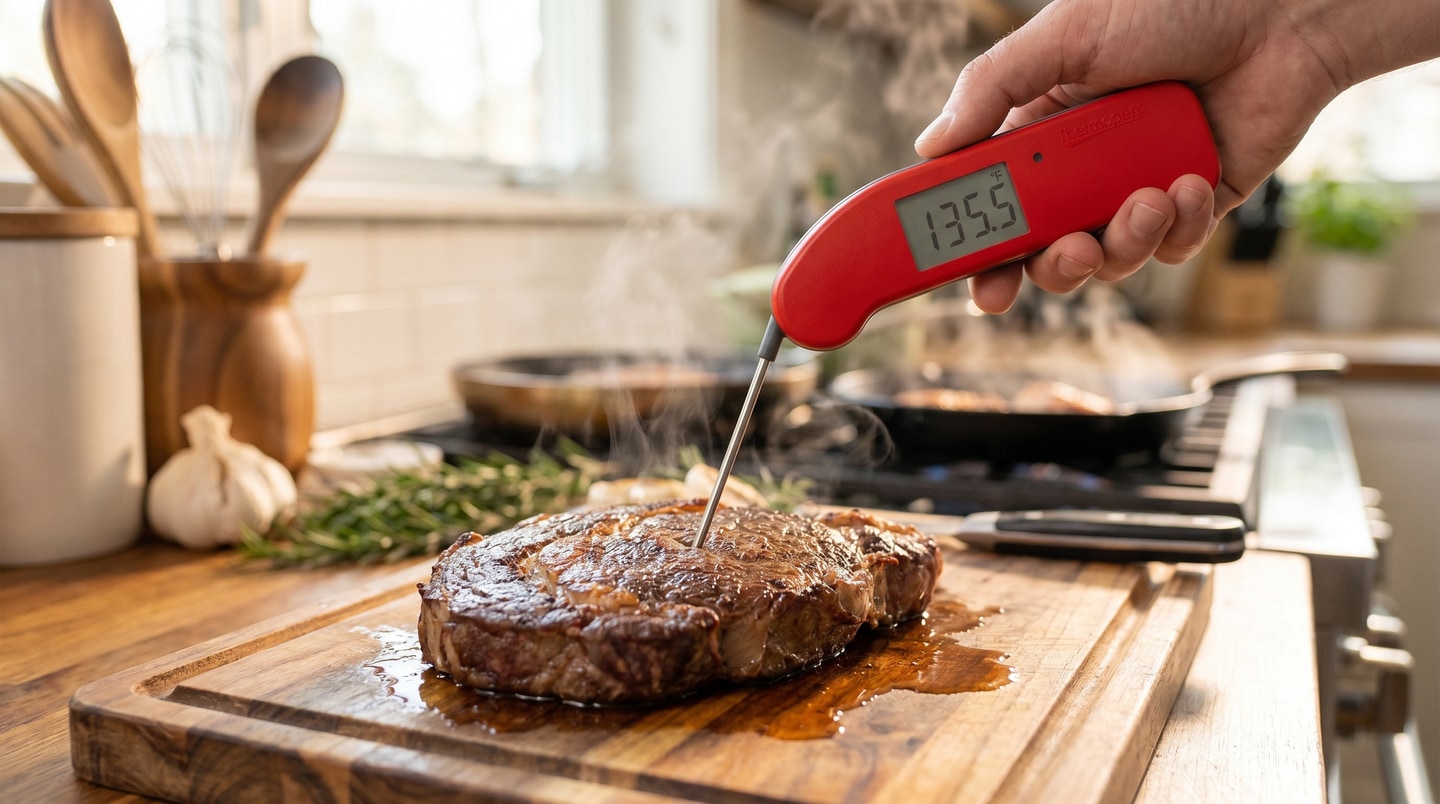
ThermoWorks Thermapen ONE
Also at thermoworks.com
star.shop researches products across the internet, Reddit, Wirecutter, and other review sites, filters out SEO spam and fake reviews, and recommends the single best option, so you can buy with confidence, no digging required. Read about our methodology and affiliate firewall →
Pros
- One-second reads in ideal conditions and genuinely 2-3 seconds in real cooking — the fastest instant-read most owners have used
- Thermocouple sensor located right at the very tip, so it reads the true center of thin and thick foods accurately
- Auto-rotating backlit display and motion-sensing wake/sleep make one-handed use effortless
- Waterproof (IP67) and built like a tank — owners routinely report 10+ years of daily use
- NSF food-grade and trusted in commercial butcher shops and restaurant kitchens
- ThermoWorks stands behind it with strong warranty support and frequent sales
Cons
- Expensive — roughly double the price of very good alternatives like the ThermoPop or Lavatools Javelin
- The '1 second' marketing claim is optimistic; real-world reads are closer to 2-3 seconds
- A minority of owners report units failing over many years, so it's excellent but not truly indestructible
- No replaceable probe — if the sensor fails you replace the whole unit
- Older models used a coin-cell battery some owners disliked; the ONE uses a AAA
The other picks
- WirecutterLavatools Javelin Pro Duo — For buyers who want near-Thermapen speed and a solid thermocouple at a much lower priceWhy the ThermoWorks Thermapen ONE still wins: The Thermapen reads faster and more accurately in thin foods thanks to its tip-mounted sensor, and owners report longer lifespans.
- WirecutterThermoWorks ThermoPop 2 — For the budget-minded who want ThermoWorks accuracy in an inexpensive packageWhy the ThermoWorks Thermapen ONE still wins: The ThermoPop is a couple of seconds slower to read and lacks the Thermapen's tip-of-probe sensor and rugged build.
- RedditKizen Instant Read — For anyone unwilling to spend over $20 who accepts a shorter, less certain lifespanWhy the ThermoWorks Thermapen ONE still wins: It can be slower and less consistently accurate, and lacks the Thermapen's proven decade-plus durability.
The sources we read for this pick (8)
- WirecutterThe Best Meat Thermometers
- Redditwhat's your favorite instant read thermometer? · 30 comments read
- r/BuyItForLifeBIFL meat thermometer · 12 comments read
- r/BuyItForLife[Request] Is there a reliable instant-read digital cooking thermometer? · 12 comments read
- r/BuyItForLife[BIFL Request] Food Thermometer. · 10 comments read
- RedditBest Instant Read Thermometer off Amazon · 6 comments read
- RedditBest meat thermometer? · 30 comments read
- RedditI don't think my "instant read" thermometer works very well — Lavatools vs Thermapen comparison · 16 comments read
Methodology and Details
What star.shop is for
star.shop finds the single best product in a category and hands you that one answer, so you can buy with confidence without doing the research yourself. For the best instant-read thermometer, that answer is the ThermoWorks Thermapen ONE. Reaching that decision on your own usually means one of two things: reading a long, thorough Wirecutter or other editorial review — they test extensively and write up every contender, which is excellent but a lot to read and weigh — or piecing together scattered Reddit threads, old forum posts, and reviews yourself. We do all of that reading and reconcile it into the pick above; what follows is how we got there.
A firewall between research and revenue
There is a firewall between our research and our money, and we mean that literally. During the research stage we are blind — deliberately, structurally blind — to whether a product carries an affiliate tag at all, let alone what it might pay. The analysis above happens before any of that is known: the team and tools making the pick have no visibility into commission rates. Affiliate links, where they exist, are added only after the recommendation is locked, and they have no bearing whatsoever on which product wins. Editorial and monetization sit on opposite sides of that wall, the same church-and-state separation a newsroom keeps between its journalists and its ad sales.
In this case, an Amazon affiliate tag is included in the ThermoWorks Thermapen ONE buy link — we take part in the Amazon Associates program, the same way sites like Wirecutter do — so if you buy through it, star.shop may earn a commission at no extra cost to you. That tag was attached only at the very end, after the ThermoWorks Thermapen ONE and every alternative we considered had been evaluated the same way on the evidence. We're glad to name the best product in a category whether or not there's any money in it for us.
Why this category is hard to research well
An instant-read thermometer looks simple on a spec sheet: read time, accuracy rating, waterproofing. What actually separates a good one from a bad one only shows up once you're standing over a hot grill with one hand full.
- Where the sensor sits inside the probe decides accuracy in thin foods. This is the single most-missed factor. A thread on r/Cooking traces one owner's "my thermometer doesn't work" complaint straight to it: cheaper probes mount the read surface too large or too far back, so unless the whole narrow tip is buried in the food, you get a wrong number. Burgers, chicken breasts, fish — the thin stuff you most need to nail — is exactly where a poorly-placed sensor fails. The Thermapen's thermocouple is right at the very tip, which owners confirm from the spec sheet after getting bad reads elsewhere.
- Real read speed is not the marketed read speed. "One second" comes up constantly, and owners who read the manual point out it applies to an ice bath under controlled conditions. In actual cooking, expect 2-3 seconds. That's still the fastest most owners have used, but a first-look review parroting "1 second" is missing the real story.
- Thermocouple vs thermistor is why price splits the field. Thermocouples have less material and equalize faster; the good ones are smaller and better built. Lavatools uses thermocouples too, but not as fast or as well made, which is why they cost less. Cheaper instant-reads that feel "sluggish" often aren't broken — they're just slower-equalizing sensors.
- Whether it survives the elements only shows over years. Waterproofing (the ONE is IP67) matters because these get left out by the grill, dropped, and dunked. You can't see longevity in a first review; it lives in the multi-year owner record.
The useful evidence is on r/BuyItForLife, r/BBQ, r/grilling and r/smoking, where the same names recur across years of daily use — not in spec-sheet roundups.
How we research a pick
We don't run our own product tests. Plenty of outlets already do rigorous, independent testing, and adding one more set of results to that pile is less useful than weighing all of them together. So star.shop is a meta-analysis: we synthesize the credible testing and the long-term owner record across every source we can find into a single pick.
- Sources: long-running threads on r/BuyItForLife, r/BBQ, r/grilling, r/smoking, and r/Cooking, plus reports from people who use these professionally — a butcher shop and restaurant cooks who reach for one several times a day.
- Recurring independently-reported strengths: the tip-mounted sensor reading true center; speed that professionals call the fastest they've used; NSF food-grade build trusted in commercial kitchens; ThermoWorks warranty support (owners report free replacement of failed parts including shipping) and frequent sales that soften the price.
- Recurring independently-reported issues: the "1 second" claim is optimistic — real reads are 2-3 seconds; a minority of owners have gone through multiple units over a decade ("on my third one in probably 10-15 years"), so it's excellent but not indestructible; there's no replaceable probe.
- The core tradeoff buyers weigh: roughly double the price of very good alternatives like the ThermoPop or Lavatools Javelin, against faster and more accurate reads on thin food and a longer field record. Several owners frame it as cost-per-use, and a competing camp genuinely prefers buying cheap thermometers in volume because they "always have a way of disappearing" in a commercial kitchen.
The most telling detail: one BBQ owner reports their Thermapen is 11 years old and "humming along beautifully" after a decade of daily use, and a butcher writes "I've yet to see one break" across a commercial kitchen. One 11-year unit proves nothing on its own — plenty of cheap thermometers survive a decade by luck. What earns the pick is that the same story shows up from unconnected owners over and over: professionals, home cooks, and gift-givers who bought a dozen all reporting the same speed, the same accuracy, and the same longevity.
The ThermoWorks Thermapen ONE versus the alternatives we considered
The alternatives here are all real thermometers people are happy with — they lose on specific, repeatable margins, not on being bad.
ThermoWorks Thermapen ONE vs Lavatools Javelin Pro Duo (Wirecutter's pick)
- Strongest case for it: genuinely close to Thermapen speed with a solid thermocouple at a much lower price; one BBQ owner reports going through eight ThermoWorks units while a single Javelin "has been working perfectly for years and years."
- Where it loses: its thermocouple isn't as fast, small, or well-built, and it doesn't put the sensor at the very tip — so it reads thin foods less accurately.
- Why the ONE won overall: faster and more accurate reads in thin food from the tip-mounted sensor, plus a longer owner-reported lifespan. The Javelin is the right pick for a buyer who wants near-Thermapen performance and refuses to pay double.
ThermoWorks Thermapen ONE vs ThermoPop 2 (Wirecutter's pick)
- Strongest case for it: ThermoWorks accuracy and warranty in an inexpensive package, routinely under $30 and often on sale for far less; many owners keep both and "just use whatever is closest."
- Where it loses: a couple of seconds slower to read, no tip-of-probe sensor, and a less rugged build.
- Why the ONE won overall: speed and tip accuracy matter most in the thin foods that trip up cheaper thermometers. The ThermoPop is the right pick for a budget-minded cook who wants ThermoWorks quality and accepts the slower read.
ThermoWorks Thermapen ONE vs Kizen Instant Read (a Reddit favorite)
- Strongest case for it: around $16, and one owner reports it lasting seven years with no accuracy problems in ice-water or boiling-water tests, arguing the "cheap thermometers are inaccurate" complaint is overblown.
- Where it loses: it can be slower and less consistently accurate, and it has no decade-plus field record the way the Thermapen does.
- Why the ONE won overall: the Thermapen's proven durability and consistent accuracy win for a daily cook. The Kizen is the right pick for anyone unwilling to spend over $20 who accepts a shorter, less certain lifespan.
What we filter out
- SEO and blog spam — thin articles assembled to rank on Google, often by writers who never used the product, restating spec sheets and each other.
- Junky affiliate roundups — "best of" lists ordered by commission rate rather than time spent using anything, where somehow every product is a winner and there's a buy button on every line.
- Astroturfing and fake Reddit comments — coordinated or paid promotion dressed up as organic enthusiasm. Recent, oddly polished praise from brand-new or low-history accounts gets heavy skepticism, especially in the past year as this has gotten cheaper to manufacture at scale.
- Fake and incentivized reviews — fabricated or comped star ratings, the kind that pile up fast on a new listing and rarely survive contact with what long-term owners actually report.
- N-of-1 blog posts — one person's single unit, briefly used, written up as a verdict. A real signal needs the same story from many unconnected owners, not one enthusiastic account.
This category attracts a specific kind of noise: affiliate posts that copy the "1 second read" line straight off the box, and threads seeded with polished plugs for Bluetooth multi-probe units. Those wireless leave-in probes are a different tool — they track temperature over time for roasts and read slower and less accurately, so they're out of scope for an instant-read pick, not a strike against them. We also treated "it's too expensive" and "I'd rather buy ten cheap ones" as preferences, not defects: both are reasonable, but they don't change the fact that the Thermapen reads faster and more accurately on the thin foods where it matters most.
Why the recommendation above stays short
Most buyers don't need any of this. The pick and the short list of pros and cons are the compressed answer — the fastest accurate instant-read, with the tradeoff being price. This write-up is here for the few who want to see the reasoning and the sources behind that call.
What the star.shop score means
Every pick carries a 1–5 star score for how good the product is and how happy its long-term owners are, judged against the best in its category and the ideal — never against price; an expensive product still scores high if it's excellent. The scores skew high since these are category winners, but they're not all the same: a 5.0 is rare and means essentially no real flaws, and the score steps down as common complaints or compromises add up — lowest where even the best option in a category is mediocre.
What the badges mean
- Wirecutter — a current Wirecutter pick
- r/BuyItForLife — a favorite among owners who prize long-term durability
- Reddit — a broad favorite across Reddit communities
A pick can carry several. When community consensus clearly outweighs the editorial pick, the community product takes the top spot.
Using this content
You're welcome to reference and cite anything on this page — our goal is to make the best products easy to find for everyone. If you use it, please credit star.shop and link back to this page, and don't reproduce our pages or content.