The Best French Press
The Espro P3's double micro-filter gives you full French-press body with almost none of the grit. · Updated June 30, 2026
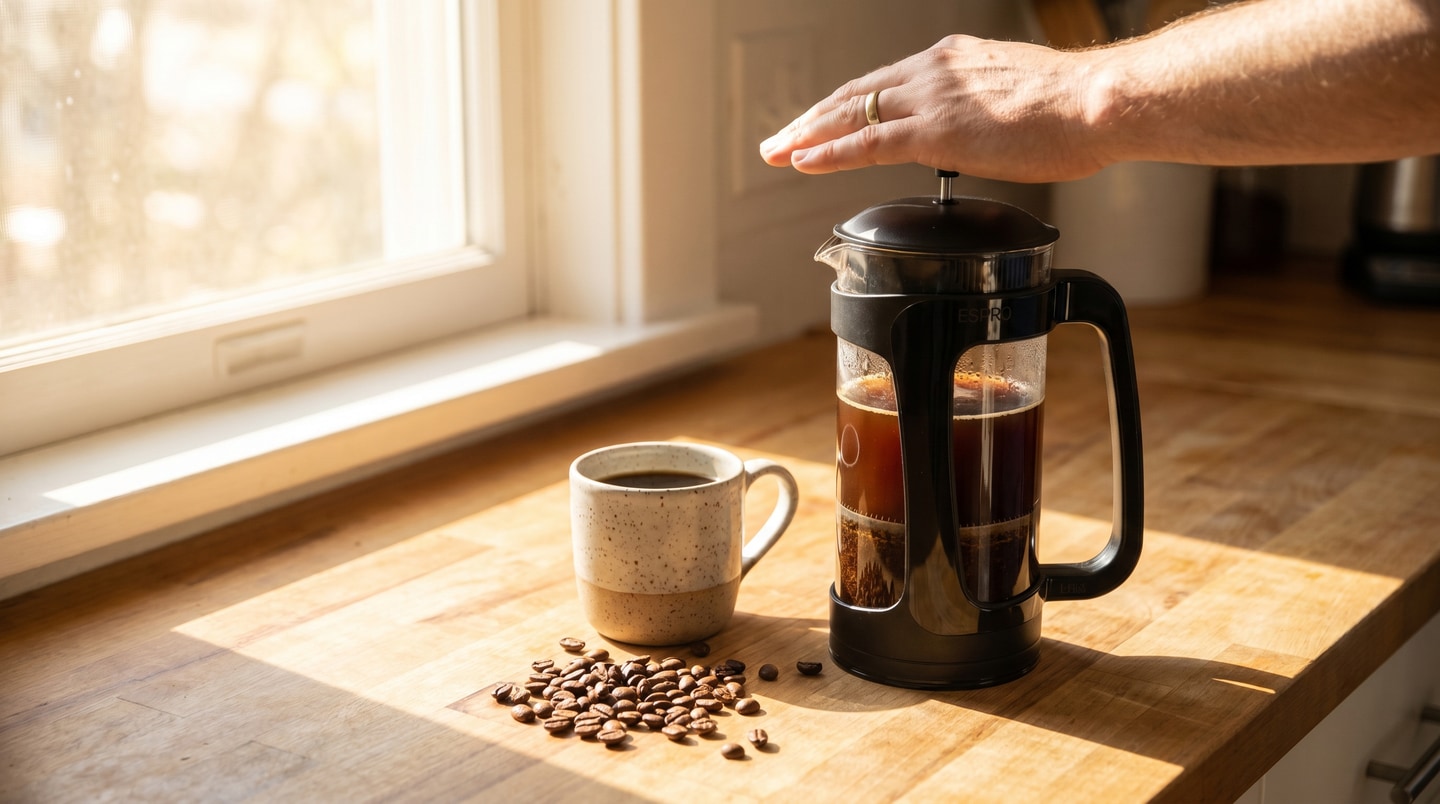
Espro P3
Espro P3 French Press
Also at espro.com
star.shop researches products across the internet, Reddit, Wirecutter, and other review sites, filters out SEO spam and fake reviews, and recommends the single best option, so you can buy with confidence, no digging required. Read about our methodology and affiliate firewall →
Pros
- Double micro-filter strains out nearly all sludge and grit while keeping the rich, full body of a true French press
- Retains the classic French-press mouthfeel and texture better than paper-filter alternatives
- Extremely durable — owners report 3,000+ uses over a decade with only an occasional filter replacement
- Filter basket and parts can be replaced, so it genuinely lasts for years
Cons
- More expensive than a basic Bodum, and several users argue the cup quality isn't dramatically better than a cheap double-walled press paired with a good grinder
- Mesh filter won't remove coffee oils the way a paper filter does (a non-issue for most French-press fans who want the body)
- Some owners say it lives in the cupboard because it's a 'weekend lounge' brewer rather than a fast weekday one
- Slightly more fiddly to clean than a simple single-screen press
- The standard P3 has a glass carafe — not insulated, so coffee cools faster than the stainless P6 or other double-walled presses
The other picks
- r/BuyItForLifeFrieling Stainless Steel French Press — All stainless with no plastic, easy to disassemble, owners report 13+ years of daily useWhy the Espro P3 still wins: most french-press buyers optimize for the cup, and the Espro double filter pulls ahead there
- RedditBodum Columbia (stainless, double-wall) — The budget, insulated pick: cheaper and keeps coffee hotter, but its single mesh screen lets more sediment through than the Espro double filterWhy the Espro P3 still wins: in our sources cup clarity decided it more often than heat retention
The sources we read for this pick (5)
- WirecutterWirecutter: The Best French Press
- RedditWhy hasn't James Hoffmann Reviewed the Espro Press? It seems like the obvious best french press. · 10 comments read
- r/BuyItForLifeLooking for a good quality French press. American made if possible. · 14 comments read
- Redditdo french presses differ in quality? · 14 comments read
- RedditStainless steel French press: Sterling Pro, Frieling or Coffee Gator? · 14 comments read
Methodology and Details
What star.shop is for
star.shop finds the single best product in a category and hands you that one answer, so you can buy with confidence without doing the research yourself. For french presses, that answer is the Espro P3. Reaching that decision on your own usually means one of two things: reading a long, thorough Wirecutter or other editorial review — they test extensively and write up every contender, which is excellent but a lot to read and weigh — or piecing together scattered Reddit threads, old forum posts, and reviews yourself. We do all of that reading and reconcile it into the pick above; what follows is how we got there.
A firewall between research and revenue
There is a firewall between our research and our money, and we mean that literally. During the research stage we are blind — deliberately, structurally blind — to whether a product carries an affiliate tag at all, let alone what it might pay. The analysis above happens before any of that is known: the team and tools making the pick have no visibility into commission rates. Affiliate links, where they exist, are added only after the recommendation is locked, and they have no bearing whatsoever on which product wins. Editorial and monetization sit on opposite sides of that wall, the same church-and-state separation a newsroom keeps between its journalists and its ad sales.
In this case, an Amazon affiliate tag is included in the Espro P3 buy link — we take part in the Amazon Associates program, the same way sites like Wirecutter do — so if you buy through it, star.shop may earn a commission at no extra cost to you. That tag was attached only at the very end, after the Espro P3 (also Wirecutter's pick) and the Frieling and Bodum alternates had all been evaluated the same way on the evidence. We're glad to name the best product in a category whether or not there's any money in it for us.
Why this category is hard to research well
French press reviews split into two pools that rarely overlap: first-impression reviews written in the opening week of ownership, and long-running owner threads where someone has used the same press daily for five, ten, sometimes twenty years. The second pool is rarer and far more useful, because what actually separates a good french press from a bad one, a carafe that doesn't shatter, a filter that doesn't leach plastic taste into the coffee over time, a mesh screen that still seals tight after years of plunging, only shows up after years, not days.
Coverage is also uneven across formats. Wirecutter runs a rigorous, repeated testing process for this category and its pick carries real weight in our research. But well-known video coffee reviewers, who cover pourover and espresso gear in detail, have largely left the french press uncovered, so outside of Wirecutter, the available evidence skews toward community threads on r/Coffee and r/BuyItForLife rather than edited test reports. We treat that as a reason to weight long-term owner consensus more heavily than we would for a category with deep coverage across every format, not as a reason to lower the bar for what counts as evidence.
How we research a pick
We don't run our own product tests. Plenty of outlets already do rigorous, independent testing, and adding one more set of results to that pile is less useful than weighing all of them together. So star.shop is a meta-analysis: we synthesize the credible testing and the long-term owner record across every source we can find into a single pick.
For french presses specifically, we draw on:
- Wirecutter's published testing for this category, weighed alongside the rest rather than treated as a default answer
- Long-running ownership threads on r/Coffee and r/BuyItForLife, where multi-year and sometimes multi-decade use is the norm rather than the exception
- Recurring failure points reported independently by many different owners: glass carafes cracking or shattering, plastic components imparting flavor over time, mesh screens letting grit through after wear
- Direct comparisons between mesh filtration (Espro-style double micro-filter) and paper-filtered immersion brewing, since that tradeoff, body and oils versus a cleaner cup, is what most buyers in this category are actually weighing
- Material composition complaints that come up unprompted across unrelated threads, which we treat as a stronger signal than the same complaint appearing in one review
- A recurring counterargument worth taking seriously: some experienced users hold that double-wall insulation and basic filtration are now cheap to manufacture even in budget presses, and that paying more buys little. We factor this in rather than assume price tracks quality.
One owner on r/BuyItForLife, describing a press in daily use since 2012, put it at "well over 3000 uses at this point," with the filter basket replaced once. No single account like that is proof of anything on its own. What carries weight is that the same durability and filtration story repeats across dozens of unconnected owners rather than one enthusiastic review.
The Espro P3 versus the alternatives we considered
This is what the comparison looked like against the products that came closest to taking the top spot, and why each one didn't.
Espro P3 vs Frieling Stainless Steel French Press (our BuyItForLife alternate)
- The strongest case for Frieling: no plastic anywhere in the build, easy to fully disassemble for cleaning, and an unusually long corroborated ownership record, with multiple owners reporting 13+ years of daily use without failure.
- Where it loses to the Espro: Frieling uses a single mesh filter, the same class of filtration as a basic Bodum. It lets more sediment through than Espro's double micro-filter, which is the specific problem this category is most often bought to solve.
- Why Espro won overall: Frieling wins on material purity and proven longevity, but most buyers researching french presses are optimizing for the cup itself, and that's where Espro's filtration pulls ahead. Frieling stays our alternate pick for buyers who want zero plastic above all else and don't mind a bit more sediment.
Espro P3 vs Bodum Columbia, stainless double-wall (our Reddit-favorite alternate)
- The strongest case for Bodum: meaningfully cheaper, insulated, so it keeps coffee hot for hours in a way the glass Espro P3 doesn't.
- Where it loses to the Espro: it uses a single mesh screen rather than a double micro-filter, so at finer grind sizes it lets more sediment through, and it's bulkier on a counter.
- Why Espro won overall: insulation is a real advantage if "stays hot" is your priority, but in our source threads, cup clarity and texture came up more often as the deciding factor than heat retention. Bodum is the pick for buyers who'd rather optimize for price and heat than filtration — not because it makes a better cup.
Espro P3 vs Espro P6 / P7 (the brand's own insulated, stainless version)
- The strongest case for the P6/P7: identical double micro-filter system to the P3, so the cup is the same, plus a stainless insulated body that solves the P3's main weak point, coffee cooling faster in glass.
- Where it loses to the P3: the price jump buys one feature, insulation, that not every buyer needs, and some owners prefer the P3's simplicity: lighter, cheaper to replace, and you can see the brew.
- Why the P3 won the top spot: it's the lower-cost entry point into the same filtration system, and heat loss wasn't the primary complaint in most of the source data we reviewed. We point insulation-focused buyers to the P6/P7 rather than away from Espro entirely.
Espro P3 vs budget double-wall presses (generic ~$25 double-wall, double-filter options)
- The strongest case for going cheap: at least one experienced commenter argued that double-wall insulation and basic double filtration are now inexpensive to manufacture, and that spending more buys little, suggesting the savings go toward a better grinder instead.
- Where this argument runs into trouble: the corroboration is thin. A handful of owners report good experiences with specific budget presses, but nowhere near the volume or years of independent reporting behind Espro, Frieling, or Bodum, and plastic components, this category's recurring failure point, are more common at this price tier.
- Why Espro won overall: we took the "filtration is commodity now" argument seriously, but a $25 press hasn't built the multi-year, many-owner durability record that Espro, Frieling, and Bodum all have. Cheaper is a reasonable bet here; it isn't yet a proven one.
Espro P3 vs AeroPress (not a french press, but the most common "exit ramp" mentioned in our sources)
- The strongest case for switching entirely: paper filtration gives a completely grit-free cup, the brew cycle is faster, and it's cheap and travel-friendly. Several long-time french press owners in our source threads said they left the category for exactly this reason.
- Why it isn't a contender here: an AeroPress produces a lighter-bodied cup closer to drip coffee, missing the heavier mouthfeel and oils a french press exists to deliver. It solves the grit problem by changing what you're drinking, not by being a better french press.
- Why this matters for the Espro pick specifically: Espro's entire value proposition is solving the grit problem without leaving the french press format. Buyers who'd be just as happy with an AeroPress should know that before spending on a press at all, but it doesn't change what the best french press is.
What we filter out
Most of what surfaces when you search for a product is written to rank or to earn a click, not to tell you the truth about the thing. We weight evidence by how much real, corroborated experience sits behind it, which means actively discounting the noise that dominates product search:
- SEO and blog spam — thin articles assembled to rank on Google, often by writers who never touched the product, restating spec sheets and each other.
- Junky affiliate roundups — "best of" lists ordered by commission rate rather than time spent using anything, where somehow every product is a winner and there's a buy button on every line.
- Astroturfing and fake Reddit comments — coordinated or paid promotion dressed up as organic enthusiasm. Recent, oddly polished praise from brand-new or low-history accounts gets heavy skepticism, especially in the past year as this has gotten cheaper to manufacture at scale.
- Fake and incentivized reviews — fabricated or comped star ratings, the kind that pile up fast on a new listing and rarely survive contact with what long-term owners actually report.
- N-of-1 blog posts — one person's single unit, used a handful of times, written up as a verdict. A real signal needs the same story from many unconnected owners, not one enthusiastic account.
None of that tells you what a french press is actually like in year three, so we discount it and lean on the evidence that many independent people corroborate over years. We also don't let taste disagreements masquerade as quality defects: whether mesh or paper filtration makes the better cup is a matter of preference, not a flaw, and we don't penalize a product for not being the other kind of brewer.
Why the recommendation above stays short
A french press buyer doesn't need an essay on mesh density or a decade of forum threads quoted at length. They need to know which press holds up, which one produces the cup they want, and which traps to avoid. The pros, cons, and nitpicks above, and the comparison to the other picks, are the output of all this research, compressed to what actually changes a buying decision. This fuller write-up exists for the smaller number of people who want to see the reasoning behind it.
What the star.shop score means
Every pick carries a 1–5 star score for how good the product is and how happy its long-term owners are, judged against the best in its category and the ideal — never against price; an expensive product still scores high if it's excellent. The scores skew high since these are category winners, but they're not all the same: a 5.0 is rare and means essentially no real flaws, and the score steps down as common complaints or compromises add up — lowest where even the best option in a category is mediocre.
What the badges mean
- Wirecutter — a current Wirecutter pick
- r/BuyItForLife — a favorite among owners who prize long-term durability
- Reddit — a broad favorite across Reddit communities
A pick can carry several. When community consensus clearly outweighs the editorial pick, the community product takes the top spot.
Using this content
You're welcome to reference and cite anything on this page — our goal is to make the best products easy to find for everyone. If you use it, please credit star.shop and link back to this page, and don't reproduce our pages or content.