The Best Camping Lantern
The flashlight-nerd favorite: high-CRI, warm-to-cool color tuning, all-weekend runtime, and it doubles as a power bank. · Updated June 26, 2026
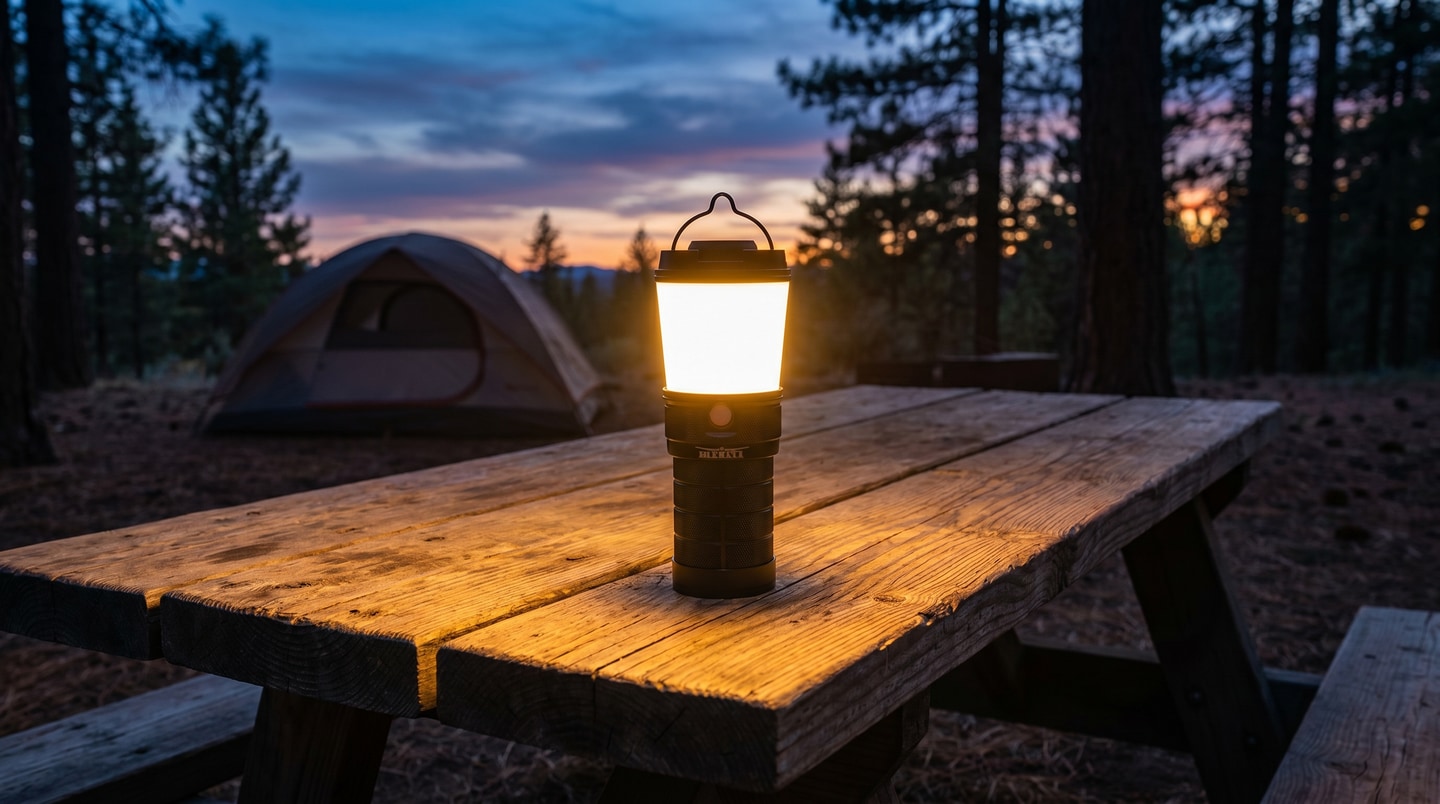
Sofirn BLF LT1
Also at Walmart
star.shop researches products across the internet, Reddit, Wirecutter, and other review sites, filters out SEO spam and fake reviews, and recommends the single best option, so you can buy with confidence, no digging required. Read about our methodology and affiliate firewall →
Pros
- Switchable warm-to-cool color temperature with notably high CRI — campsites and tents actually look natural, not washed out
- Massive runtime: the four-cell LT1 easily lasts a full weekend of car camping on a single charge
- Doubles as a USB-C power bank to top off phones and other devices
- User-replaceable 18650/21700 cells, so it's genuinely a long-term keeper
- At ~600 'conservative' lumens it punches above its spec and is fully dimmable, plus has a red light mode
- Tripod-mountable and hangable for flexible placement around a site
Cons
- Large and fairly heavy — great for car camping and home, but too bulky for backpacking
- Sofirn's lineup (LT1, LT1S, LT1S Pro, LT1 Mini) is confusing and the Anduril interface is overkill for casual users
- Not a true generational heirloom like a 1960s Coleman fuel lantern — it's electronics that will eventually need parts
- Cells and emitters are replaceable but require comfort handling unprotected li-ion batteries to swap them
- Like any lantern, it can be glary in your eyes at higher brightness if placed in your field of view
The other picks
- r/BuyItForLifeVintage Coleman 200A / 220 fuel lantern — The most truly buy-it-for-life option, but fuel-based and impractical for most modern campers
- RedditBlack Diamond Moji lantern — Cheap, tiny and beloved for lightweight tent use where the LT1 is too bulky
- RedditMPOWERD Luci inflatable solar lantern — Packs flat, solar-charged, the one many reach for when weight and size matter
- RedditFenix CL25R / CL26R — Well-built with a magnetic base and CR123 compatibility, favored for emergency kits
- RedditStreamlight Siege — Rugged, water-resistant AA/D-cell lantern liked for fishing and power outages
The sources we read for this pick (7)
- RedditA Comparison of the Best Camping Lanterns (BLF LT1 vs Streamlight vs Fenix vs LE) · 8 comments read
- r/BuyItForLifebifl camping lantern? · 20 comments read
- r/BuyItForLife[BIFL Request] LED Lantern · 12 comments read
- RedditRecommend a lantern? · 23 comments read
- RedditCan anyone recommend a camping light? · 27 comments read
- RedditAny recommendations for a lantern? · 28 comments read
- Redditany good recommendations for a LED Lantern under $50? (USB or battery) · 26 comments read
Methodology and Details
What star.shop is for
star.shop finds the single best product in a category and hands you that one answer, so you can buy with confidence without doing the research yourself. For the best camping lantern, that answer is the Sofirn BLF LT1. Reaching that decision on your own usually means one of two things: reading a long, thorough Wirecutter or other editorial review — they test extensively and write up every contender, which is excellent but a lot to read and weigh — or piecing together scattered Reddit threads, old forum posts, and reviews yourself. We do all of that reading and reconcile it into the pick above; what follows is how we got there.
A firewall between research and revenue
There is a firewall between our research and our money, and we mean that literally. During the research stage we are blind — deliberately, structurally blind — to whether a product carries an affiliate tag at all, let alone what it might pay. The analysis above happens before any of that is known: the team and tools making the pick have no visibility into commission rates. Affiliate links, where they exist, are added only after the recommendation is locked, and they have no bearing whatsoever on which product wins. Editorial and monetization sit on opposite sides of that wall, the same church-and-state separation a newsroom keeps between its journalists and its ad sales.
In this case, an Amazon affiliate tag is included in the Sofirn BLF LT1 buy link — we take part in the Amazon Associates program, the same way sites like Wirecutter do — so if you buy through it, star.shop may earn a commission at no extra cost to you. That tag was attached only at the very end, after the Sofirn BLF LT1 and every alternative we considered had been evaluated the same way on the evidence. We're glad to name the best product in a category whether or not there's any money in it for us.
Why this category is hard to research well
A camping lantern looks simple on a spec sheet — lumens, runtime, charging port — and that's exactly the trap. The numbers that get printed rarely track with what actually makes one pleasant to sit under all evening.
Three things decide it, and none show up in a first-look review:
- Light quality, not brightness. The people who use lanterns most report that high CRI and a tunable warm-to-cool color temperature change the experience more than raw lumens. One owner put it plainly: seeing his tent and campsite in high-CRI light was "a HUGELY different experience than seeing it with 3-400 more lumens at 7000K." Cheap lanterns chase big lumen figures at a cold, washed-out tint. You only feel the difference after living with a good one.
- Runtime under real use, at the brightness you'll actually run. A lantern's headline runtime is usually its dimmest setting. What matters is whether it survives a full weekend at a usable level. That's a use-it-and-see number, not a box number.
- Whether it fits the job you're doing. The same lantern that's perfect on a picnic table is dead weight in a backpack. Bulk, weight, and how you mount or hang it decide whether a lantern gets used or left in the car. This is where most "best lantern" lists go wrong: they pick one winner for jobs that have different answers.
The good evidence lives where people own several lanterns and compare them directly — r/flashlight, r/BuyItForLife, and the camping subreddits — plus budgetlightforum, where the LT1 was designed and vetted. Those are the threads where owners admit which lights they stopped using and why.
How we research a pick
We don't run our own product tests. Plenty of outlets already do rigorous, independent testing, and adding one more set of results to that pile is less useful than weighing all of them together. So star.shop is a meta-analysis: we synthesize the credible testing and the long-term owner record across every source we can find into a single pick.
- Sources: r/flashlight (the LT1's home crowd), r/BuyItForLife, r/CampingGear, r/camping, and budgetlightforum, where the "BLF" in the name comes from.
- Recurring praise, independently reported: the switchable warm/cool tint and high CRI; the four-cell LT1's ability to run a full weekend (two nights at full power) on one charge; the USB-C power-bank function; user-replaceable 18650/21700 cells; and that it reads brighter than its "conservative" 600-lumen rating.
- Recurring complaints, independently reported: it's large and heavy — several owners say it's not worth carrying anywhere but home or a campsite reachable by car; like any diffused lantern it glares in your eyes at higher brightness; Sofirn's model lineup (LT1, LT1S, LT1S Pro, Mini) is confusing, and the Anduril interface is more than casual users want.
- The core tradeoff buyers weigh: light quality and runtime versus packability. The LT1 wins the first two decisively and loses the third, which is why backpackers reach for something smaller.
The most telling detail: a car camper described charging the LT1 over USB-C before a trip, mounting it on a camera tripod, and having it last the whole weekend — two nights at full power on its four 18650s. That's the LT1's core pitch in one anecdote. One account proves nothing on its own. What earns the pick is that the same story — full weekend, tripod mount, high CRI, doubles as a power bank — keeps surfacing from unconnected owners across multiple subreddits, including flashlight hobbyists who own a dozen lanterns and still reach for this one.
The Sofirn BLF LT1 versus the alternatives we considered
Each of these lost to the LT1 for a specific reason, and each is still the right call for a specific buyer.
Sofirn BLF LT1 vs Vintage Coleman 200A / 220 fuel lantern
- The strongest case: it's the most genuinely buy-it-for-life lantern anyone in the threads could name — a 1960s Coleman that lights up an entire campsite like nothing electric.
- Where it loses: it burns liquid fuel, which owners repeatedly flag as impractical and, for some, a fire-safety non-starter; it can't charge your phone and needs mantles and fuel handling.
- Why the LT1 won: most modern campers want rechargeable, tunable, USB-C light they can also power devices from. Buy the Coleman if you specifically want a fuel lantern that will outlive you and don't mind the ritual.
Sofirn BLF LT1 vs Black Diamond Moji lantern
- The strongest case: cheap (around $25 for the base version), tiny, and widely loved as a tent light — an adjustable dispersed glow that's plenty for reading or cooking.
- Where it loses: it has no color-temperature control, far less runtime, no power-bank function, and much less light overall.
- Why the LT1 won: for a campsite you want CRI, runtime, and output the Moji can't match. Buy the Moji if you need something small and light to hang in a tent and nothing more.
Sofirn BLF LT1 vs MPOWERD Luci inflatable solar lantern
- The strongest case: it packs flat, charges from the sun, weighs almost nothing, and is the light several owners admit they reach for over fancier options when weight and size matter.
- Where it loses: it's dimmer, has no color tuning, and can't run a weekend at the output or quality the LT1 delivers.
- Why the LT1 won: it's built for car camping and home use where packability isn't the constraint. Buy the Luci if you're counting grams and space — it's the honest answer when the LT1 is simply too big.
Sofirn BLF LT1 vs Fenix CL25R / CL26R
- The strongest case: well-built with a strong magnetic base for hands-free work, and CR123 compatibility gives cells a ~10-year shelf life — a real advantage for an emergency or earthquake kit.
- Where it loses: no warm/cool tint tuning, no all-weekend four-cell runtime, and it's oriented toward emergency use rather than long evenings under good light.
- Why the LT1 won: for actual camping the LT1's light quality and runtime pull ahead. Buy the Fenix if you're building a preparedness kit and value the magnet and long-shelf-life cells.
Sofirn BLF LT1 vs Streamlight Siege
- The strongest case: rugged and water-resistant, runs on AA or D cells, with a long low-mode runtime — owners like it for night fishing and power outages.
- Where it loses: no color-temperature control, no USB-C power-bank function, and the D-cell version is heavy without the LT1's light quality.
- Why the LT1 won: the LT1 delivers better light and a full weekend on rechargeable cells you can top your phone off with. Buy the Siege if you want a tough, disposable-battery lantern for fishing and outages where you'd rather not manage lithium cells.
What we filter out
- SEO and blog spam — thin articles assembled to rank on Google, often by writers who never used the product, restating spec sheets and each other.
- Junky affiliate roundups — "best of" lists ordered by commission rate rather than time spent using anything, where somehow every product is a winner and there's a buy button on every line.
- Astroturfing and fake Reddit comments — coordinated or paid promotion dressed up as organic enthusiasm. Recent, oddly polished praise from brand-new or low-history accounts gets heavy skepticism, especially in the past year as this has gotten cheaper to manufacture at scale.
- Fake and incentivized reviews — fabricated or comped star ratings, the kind that pile up fast on a new listing and rarely survive contact with what long-term owners actually report.
- N-of-1 blog posts — one person's single unit, briefly used, written up as a verdict. A real signal needs the same story from many unconnected owners, not one enthusiastic account.
This category attracts a specific kind of noise: threads full of drive-by "amayon has nice options" and single-mention no-name lanterns with 5,000mAh listings and IPX4 ratings, plus at least one link to a suspiciously polished third-party review site. Those don't count. We also separate preference from defect — "lanterns are useless, use a headlamp" is a real workflow, not a mark against the LT1 — and we keep the LT1's size in its lane: being too bulky for backpacking isn't a flaw, it's the wrong job. It's a car-camping and home light, and it's judged on light quality, runtime, and features, which is what the field record actually decides.
Why the recommendation above stays short
Most people don't need this whole write-up. The pick and the pros and cons at the top are the compressed version — a warm-to-cool, high-CRI lantern that runs a full weekend and doubles as a power bank, with the honest catch that it's heavy and not for backpacking. This section is here for the few who want to see the reasoning and the alternatives we passed over before they buy.
What the star.shop score means
Every pick carries a 1–5 star score for how good the product is and how happy its long-term owners are, judged against the best in its category and the ideal — never against price; an expensive product still scores high if it's excellent. The scores skew high since these are category winners, but they're not all the same: a 5.0 is rare and means essentially no real flaws, and the score steps down as common complaints or compromises add up — lowest where even the best option in a category is mediocre.
What the badges mean
- Wirecutter — a current Wirecutter pick
- r/BuyItForLife — a favorite among owners who prize long-term durability
- Reddit — a broad favorite across Reddit communities
A pick can carry several. When community consensus clearly outweighs the editorial pick, the community product takes the top spot.
Using this content
You're welcome to reference and cite anything on this page — our goal is to make the best products easy to find for everyone. If you use it, please credit star.shop and link back to this page, and don't reproduce our pages or content.