The Best Backpacking Water Bottle
The thru-hiker's open secret: a cheap 1L Smartwater bottle is light, tough enough, and screws straight onto a Sawyer Squeeze. · Updated June 27, 2026
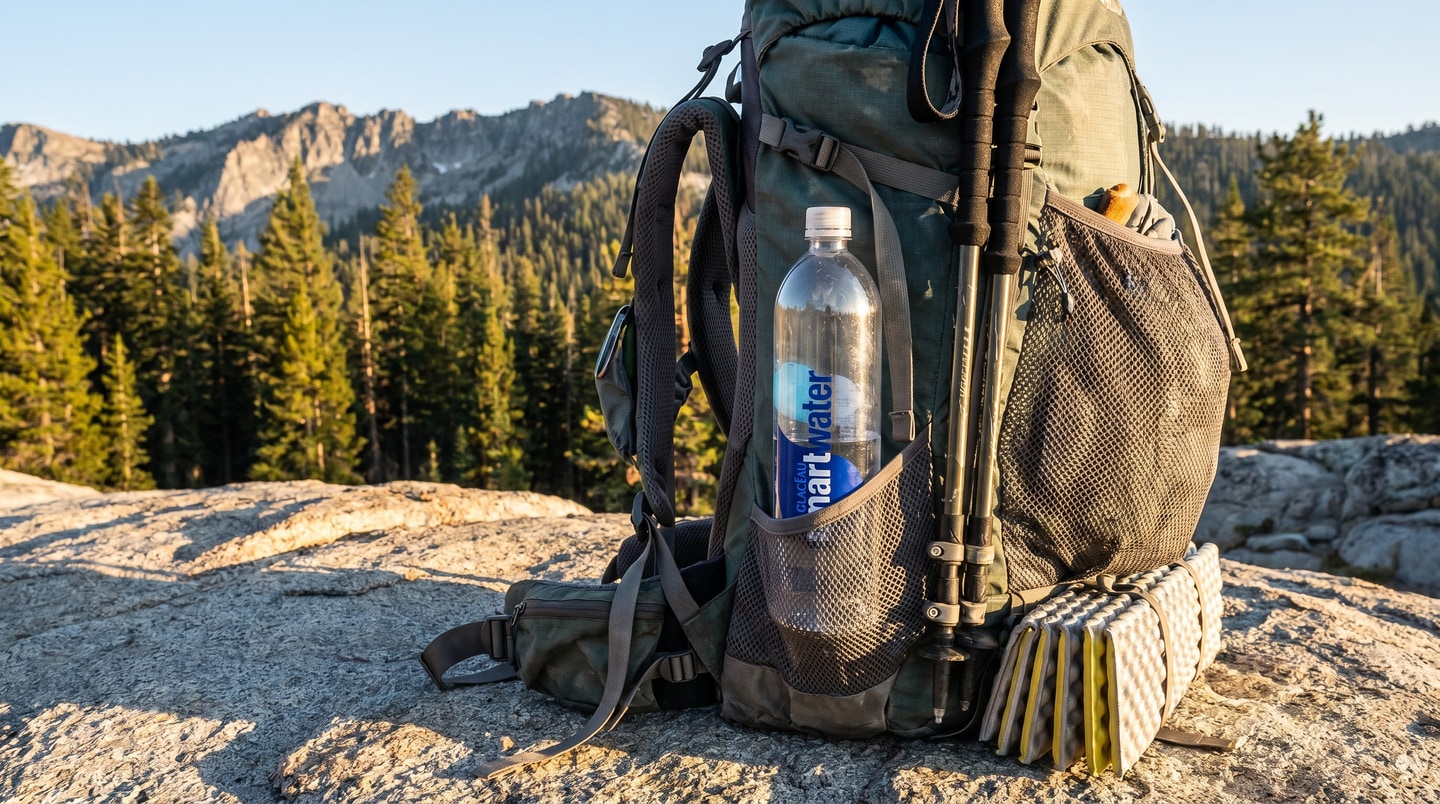
Smartwater bottle
Smartwater 1L bottle
star.shop researches products across the internet, Reddit, Wirecutter, and other review sites, filters out SEO spam and fake reviews, and recommends the single best option, so you can buy with confidence, no digging required. Read about our methodology and affiliate firewall →
Pros
- Extremely light — roughly 34–44g empty for a full liter, a fraction of a Nalgene's 6 oz
- Threads screw directly onto the Sawyer Squeeze and most popular inline filters, making it the de facto thru-hiker standard
- Slim profile slides easily into pack side pockets and shoulder-strap pockets
- Costs about $2 and is available at nearly any gas station or grocery store, so replacing or resupplying is trivial
- Surprisingly durable — many hikers report a single bottle lasting an entire AT or PCT thru-hike
- Sport-cap versions allow easy one-handed drinking on the move
Cons
- Single-wall plastic offers no insulation and can pick up an off taste if left in the sun for long periods
- Not as puncture-resistant as a hard bottle — a real concern in sharp, rocky desert terrain where a failed bottle could be dangerous
- Technically a single-use bottle, so it isn't 'buy it for life' — though hikers routinely reuse the same one for years
- Sport-cap hinges can break and caps can go missing, so carrying a spare cap is wise
- Reusing the same plastic bottle long-term raises the usual microplastics/BPA concerns some users prefer to avoid
- Cannot hold boiling water, so you lose the sleeping-bag hot-water-bottle trick that a Nalgene allows
The other picks
- r/BuyItForLifeNalgene 32oz Wide Mouth — Virtually indestructible, holds boiling water, lasts decades, and is the runaway BuyItForLife favorite
- RedditCNOC Vecto 2L + Nalgene combo — Some experienced hikers find squeezing a Smartwater through a filter awkward and prefer a wide-mouth dirty bag with a Nalgene for clean water
- RedditHydrapak Stow 1L — A reusable, tough, leakproof Sawyer-compatible bottle for those who want a non-disposable option
The sources we read for this pick (4)
- RedditCarrying water · 80 comments read
- RedditWater bottle weight roundup · 80 comments read
- RedditNon-disposable water bottles? · 76 comments read
- r/BuyItForLifeAny BIFL Water Bottles? · 61 comments read
Methodology and Details
What star.shop is for
star.shop finds the single best product in a category and hands you that one answer, so you can buy with confidence without doing the research yourself. For the best backpacking water bottle, that answer is the Smartwater bottle. Reaching that decision on your own usually means one of two things: reading a long, thorough Wirecutter or other editorial review — they test extensively and write up every contender, which is excellent but a lot to read and weigh — or piecing together scattered Reddit threads, old forum posts, and reviews yourself. We do all of that reading and reconcile it into the pick above; what follows is how we got there.
A firewall between research and revenue
There is a firewall between our research and our money, and we mean that literally. During the research stage we are blind — deliberately, structurally blind — to whether a product carries an affiliate tag at all, let alone what it might pay. The analysis above happens before any of that is known: the team and tools making the pick have no visibility into commission rates. Affiliate links, where they exist, are added only after the recommendation is locked, and they have no bearing whatsoever on which product wins. Editorial and monetization sit on opposite sides of that wall, the same church-and-state separation a newsroom keeps between its journalists and its ad sales.
In this case, an Amazon affiliate tag is included in the Smartwater bottle buy link — we take part in the Amazon Associates program, the same way sites like Wirecutter do — so if you buy through it, star.shop may earn a commission at no extra cost to you. That tag was attached only at the very end, after the Smartwater bottle and every alternative we considered had been evaluated the same way on the evidence. We're glad to name the best product in a category whether or not there's any money in it for us.
Why this category is hard to research well
The thing that makes a backpacking water bottle good has almost nothing to do with how it performs sitting on a shelf or on a day hike. What actually decides it, per the research, is a narrow set of trail-specific factors:
- Filter compatibility. The reason a $2 Smartwater bottle is the thru-hiker default is that its threads screw directly onto the Sawyer Squeeze and most popular inline filters. Hikers repeatedly describe the Sawyer-plus-Smartwater setup as the reason they got into ultralight in the first place. Not every bottle plays nice here — one owner notes a HydroBlu filter "leaks with smartwater but is great with Dasani," which shows how finicky the 28mm thread standard actually is.
- Weight per liter. A Smartwater 1L runs roughly 34–44g empty. A Nalgene is 6 oz. That gap is the whole argument, and it only matters to people counting grams.
- Real-world durability in specific terrain. A single-wall bottle survives a full thru-hike for many people, but in "sharp, rocky desert terrain" a punctured bottle is a genuine safety problem. Same object, opposite verdict depending on where you hike.
None of this shows up in a first-look review. You learn whether a bottle survives an AT or PCT season by asking people who carried one from Campo, and you learn how it fits your pack's shoulder-strap pocket only after loading it. The good evidence lives in r/Ultralight and r/backpacking, where thru-hikers report what lasted the whole trail and which filter/bottle pairing actually flowed.
How we research a pick
We don't run our own product tests. Plenty of outlets already do rigorous, independent testing, and adding one more set of results to that pile is less useful than weighing all of them together. So star.shop is a meta-analysis: we synthesize the credible testing and the long-term owner record across every source we can find into a single pick.
- Sources: r/backpacking and r/Ultralight threads where the same people who use these bottles for weeks at a time compare notes — weight roundups, filter-compatibility arguments, and "what did you carry" trip reports.
- Recurring independently-reported issues: sport-cap hinges break and caps go missing (multiple hikers carry a spare cap); water picks up an off taste if the bottle sits in the sun; single-wall plastic can't hold boiling water and isn't puncture-proof; long-term reuse raises microplastics/BPA concerns that some owners deliberately avoid.
- Core tradeoffs buyers weigh: light-and-cheap-but-disposable (Smartwater) versus durable-and-reusable-but-heavy (Nalgene, metal); rigid bottle you drink from versus soft dirty bag you filter through; grams saved versus environmental and health concerns about single-use plastic.
The most telling detail is a lunch at mile 1100 on the PCT: a hiker asked two guys who started at Campo how long their Smartwater bottles lasted, and both "had their original bottles and expected them to last the whole hike." That is exactly the field record that makes this a community pick — but one PCT lunch proves nothing on its own. What earns the pick is that the same story repeats from unconnected owners: someone who "carried two the entire AT," someone with the same 1L bottle for over two years "showing no sign of giving up," and the flat consensus that Smartwater hits the light/cheap/durable trifecta.
The Smartwater bottle versus the alternatives we considered
Each alternative wins on something the Smartwater gives up, but none beats it as the general backpacking default.
Smartwater bottle vs Nalgene 32oz Wide Mouth
- Strongest case: virtually indestructible, holds boiling water (so it doubles as a sleeping-bag foot warmer), has measurement markings, and multiple owners report the same bottle still in use after decades — one has one stamped "Made in West Germany." It also skips the single-use-plastic microplastics concern.
- Where it loses: 6 oz empty versus roughly 34–44g, bulky in a pack, and a throwaway bottle won't take a pump filter that screws onto a Nalgene — but the popular inline filters are built for Smartwater threads, not Nalgene.
- Why the Smartwater won: for the ultralight thru-hiker chasing ounces on a route with water and help within reach, the weight and filter compatibility decide it. The Nalgene is the right call for cold-weather trips (hot water in the bag), rocky desert terrain where a punctured bottle is dangerous, or anyone who wants one bottle for life.
Smartwater bottle vs CNOC Vecto 2L + Nalgene combo
- Strongest case: some experienced hikers find squeezing water through a filter out of a Smartwater "so inconvenient" — hard to fill, horrible to squeeze — and prefer a wide-mouth CNOC dirty bag that's easy to scoop from, with a Nalgene holding clean water. The setup also enables gravity filtering at camp.
- Where it loses: it's a heavier, more expensive, multi-piece system, and the owner who described it admits "all of these add-ons for my Sawyer water system are adding up to be about the same as a hand pump filter."
- Why the Smartwater won: it's one $2 bottle you can resupply at any gas station. The CNOC-plus-Nalgene combo is right for the hiker who filters large volumes at camp, camps far from water, or simply hates squeezing through a narrow-mouth bottle.
Smartwater bottle vs Hydrapak Stow 1L
- Strongest case: reusable, tough, leakproof, and Sawyer-compatible — it stays rigid when full and compresses as it empties, and owners report loving them as a non-disposable replacement for the 1L Smartwater.
- Where it loses: it costs many times more than a $2 bottle you can grab anywhere, and the Smartwater's whole appeal is that replacement is trivial and nearly free.
- Why the Smartwater won: on pure light/cheap/available, the throwaway bottle wins. The Hydrapak Stow is the pick for the hiker who wants to stop contributing single-use plastic to landfills and is willing to pay for a bottle that isn't disposable.
What we filter out
- SEO and blog spam — thin articles assembled to rank on Google, often by writers who never used the product, restating spec sheets and each other.
- Junky affiliate roundups — "best of" lists ordered by commission rate rather than time spent using anything, where somehow every product is a winner and there's a buy button on every line.
- Astroturfing and fake Reddit comments — coordinated or paid promotion dressed up as organic enthusiasm. Recent, oddly polished praise from brand-new or low-history accounts gets heavy skepticism, especially in the past year as this has gotten cheaper to manufacture at scale.
- Fake and incentivized reviews — fabricated or comped star ratings, the kind that pile up fast on a new listing and rarely survive contact with what long-term owners actually report.
- N-of-1 blog posts — one person's single unit, briefly used, written up as a verdict. A real signal needs the same story from many unconnected owners, not one enthusiastic account.
A lot of the noise around this pick isn't a defect — it's preference. The microplastics and single-use-plastic objections are real and repeated, but they're a values choice, not a failure of the bottle to do its job; hikers who share those concerns are pointed to the Nalgene or Hydrapak. Likewise, "it can't hold boiling water" or "it isn't buy-it-for-life" describes a different job, not a broken product. What we weigh is whether the bottle is light, whether it screws onto the filter people actually carry, and whether it survives a season on trail — the things that decide this category.
Why the recommendation above stays short
Most buyers don't need any of this. The pick plus its pros and cons is the compressed answer: a $2 Smartwater 1L is light, tough enough for most trips, and screws straight onto a Sawyer. This longer write-up exists for the few who want to see the reasoning — the filter-thread details, the terrain caveats, and why we passed over the heavier and reusable options.
What the star.shop score means
Every pick carries a 1–5 star score for how good the product is and how happy its long-term owners are, judged against the best in its category and the ideal — never against price; an expensive product still scores high if it's excellent. The scores skew high since these are category winners, but they're not all the same: a 5.0 is rare and means essentially no real flaws, and the score steps down as common complaints or compromises add up — lowest where even the best option in a category is mediocre.
What the badges mean
- Wirecutter — a current Wirecutter pick
- r/BuyItForLife — a favorite among owners who prize long-term durability
- Reddit — a broad favorite across Reddit communities
A pick can carry several. When community consensus clearly outweighs the editorial pick, the community product takes the top spot.
Using this content
You're welcome to reference and cite anything on this page — our goal is to make the best products easy to find for everyone. If you use it, please credit star.shop and link back to this page, and don't reproduce our pages or content.